


Page 478 - Compression Machinery for Oil and Gas
P. 478
458 SECTION    III Applications


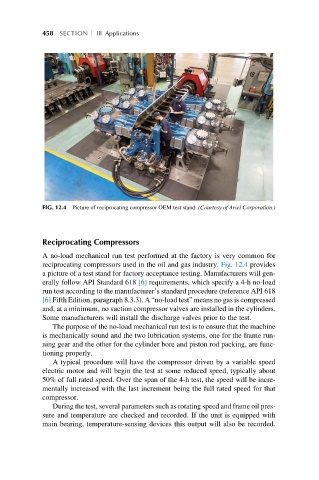
            FIG. 12.4 Picture of reciprocating compressor OEM test stand. (Courtesy of Ariel Corporation.)


            Reciprocating Compressors

            A no-load mechanical run test performed at the factory is very common for
            reciprocating compressors used in the oil and gas industry. Fig. 12.4 provides
            a picture of a test stand for factory acceptance testing. Manufacturers will gen-
            erally follow API Standard 618 [6] requirements, which specify a 4-h no-load
            run test according to the manufacturer’s standard procedure (reference API 618
            [6] Fifth Edition, paragraph 8.3.3). A “no-load test” means no gas is compressed
            and, at a minimum, no suction compressor valves are installed in the cylinders.
            Some manufacturers will install the discharge valves prior to the test.
               The purpose of the no-load mechanical run test is to ensure that the machine
            is mechanically sound and the two lubrication systems, one for the frame run-
            ning gear and the other for the cylinder bore and piston rod packing, are func-
            tioning properly.
               A typical procedure will have the compressor driven by a variable speed
            electric motor and will begin the test at some reduced speed, typically about
            50% of full rated speed. Over the span of the 4-h test, the speed will be incre-
            mentally increased with the last increment being the full rated speed for that
            compressor.
               During the test, several parameters such as rotating speed and frame oil pres-
            sure and temperature are checked and recorded. If the unit is equipped with
            main bearing, temperature-sensing devices this output will also be recorded.

