


Page 245 - Computational Fluid Dynamics for Engineers
P. 245
234                                             7.  Boundary-Layer  Equations


         f*   \  I  X


         (a)                                    (b)
                                                                 6
                                                                                7
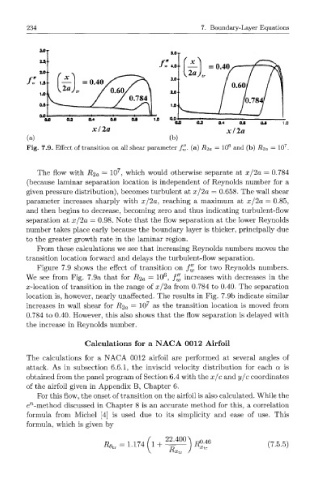
         Fig.  7.9.  Effect  of transition  on  all shear parameter  f£.  (a)  i?2a  =  10  and  (b)  i?2a  =  10 .
                                  7
            The  flow  with  i?2a  =  10 ,  which  would  otherwise  separate  at  x/2a  =  0.784
         (because  laminar  separation  location  is  independent  of  Reynolds  number  for  a
         given pressure distribution),  becomes turbulent  at  x/2a  —  0.658. The  wall  shear
         parameter  increases  sharply  with  x/2a,  reaching  a  maximum  at  x/2a  =  0.85,
         and  then  begins  to  decrease,  becoming  zero  and  thus  indicating  turbulent-flow
         separation  at  x/2a  =  0.98. Note that  the  flow  separation  at  the  lower  Reynolds
         number  takes  place  early  because  the  boundary  layer  is thicker,  principally  due
         to  the  greater  growth  rate  in  the  laminar  region.
            Prom  these  calculations  we see that  increasing  Reynolds  numbers  moves  the
         transition  location  forward  and  delays  the  turbulent-flow  separation.
            Figure  7.9  shows  the  effect  of  transition  on  f^  for  two  Reynolds  numbers.
                                               6
         We  see  from  Fig.  7.9a  that  for  i?2a  =  10 , ^  increases  with  decreases  in  the
                                                 /
         x-location  of transition  in the  range  of  x/2a  from  0.784  to  0.40.  The  separation
         location  is,  however,  nearly  unaffected.  The  results  in  Fig.  7.9b  indicate  similar
         increases  in  wall  shear  for  i?2a  =  10 7  as  the  transition  location  is  moved  from
         0.784  to  0.40.  However,  this  also  shows that  the  flow  separation  is delayed  with
         the  increase  in  Reynolds  number.

                         Calculations  for  a  N A C A  0012  Airfoil

         The  calculations  for  a  NACA  0012  airfoil  are  performed  at  several  angles  of
         attack.  As  in  subsection  6.6.1,  the  inviscid  velocity  distribution  for  each  a  is
         obtained  from the panel program  of Section  6.4 with the  x/c  and  y/c  coordinates
         of the  airfoil  given  in  Appendix  B,  Chapter  6.
            For this flow, the onset  of transition  on the  airfoil  is also calculated. While  the
          n
         e -method  discussed  in  Chapter  8  is an  accurate  method  for  this,  a  correlation
         formula  from  Michel  [4]  is  used  due  to  its  simplicity  and  ease  of  use.  This
         formula,  which  is  given  by

                                               22.400   ,0.46
                                  =  1.174  1  +                           (7.5.5)
                              R 6tr                    n
                                                        'XtT
                                               ~R  Xtr

