


Page 252 -
P. 252
7.1 / EXTERNAL DEVICES 219


                                              Address lines

                                                                           System
                                               Data lines                  bus


                                              Control lines


                                               I/O module


                                                                        Links to
                                                                        peripheral
                                                                        devices


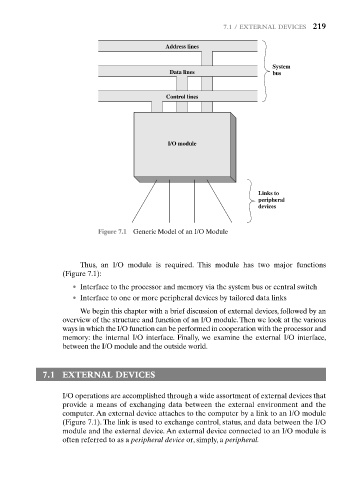
                            Figure 7.1 Generic Model of an I/O Module


                       Thus, an I/O module is required. This module has two major functions
                  (Figure 7.1):
                     • Interface to the processor and memory via the system bus or central switch
                     • Interface to one or more peripheral devices by tailored data links

                       We begin this chapter with a brief discussion of external devices, followed by an
                  overview of the structure and function of an I/O module.Then we look at the various
                  ways in which the I/O function can be performed in cooperation with the processor and
                  memory: the internal I/O interface. Finally, we examine the external I/O interface,
                  between the I/O module and the outside world.


             7.1 EXTERNAL DEVICES


                  I/O operations are accomplished through a wide assortment of external devices that
                  provide a means of exchanging data between the external environment and the
                  computer. An external device attaches to the computer by a link to an I/O module
                  (Figure 7.1). The link is used to exchange control, status, and data between the I/O
                  module and the external device. An external device connected to an I/O module is
                  often referred to as a peripheral device or, simply, a peripheral.

