


Page 253 -
P. 253
220  CHAPTER 7 / INPUT/OUTPUT

                       We can broadly classify external devices into three categories:
                     • Human readable: Suitable for communicating with the computer user
                     • Machine readable: Suitable for communicating with equipment
                     • Communication: Suitable for communicating with remote devices
                       Examples of human-readable devices are video display terminals (VDTs) and
                  printers. Examples of machine-readable devices are magnetic disk and tape systems,
                  and sensors and actuators, such as are used in a robotics application. Note that we
                  are viewing disk and tape systems as I/O devices in this chapter, whereas in Chapter 6
                  we viewed them as memory devices. From a functional point of view, these devices
                  are part of the memory hierarchy, and their use is appropriately discussed in
                  Chapter 6. From a structural point of view, these devices are controlled by I/O mod-
                  ules and are hence to be considered in this chapter.
                       Communication devices allow a computer to exchange data with a remote de-
                  vice, which may be a human-readable device, such as a terminal, a machine-readable
                  device, or even another computer.
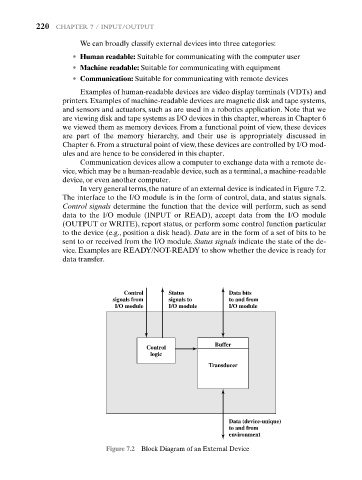
                       In very general terms, the nature of an external device is indicated in Figure 7.2.
                  The interface to the I/O module is in the form of control, data, and status signals.
                  Control signals determine the function that the device will perform, such as send
                  data to the I/O module (INPUT or READ), accept data from the I/O module
                  (OUTPUT or WRITE), report status, or perform some control function particular
                  to the device (e.g., position a disk head). Data are in the form of a set of bits to be
                  sent to or received from the I/O module. Status signals indicate the state of the de-
                  vice. Examples are READY/NOT-READY to show whether the device is ready for
                  data transfer.


                                   Control     Status           Data bits
                                signals from   signals to       to and from
                                I/O module     I/O module       I/O module


                                                            Buffer
                                         Control
                                          logic
                                                          Transducer


                                                                Data (device-unique)
                                                                to and from
                                                                environment
                              Figure 7.2 Block Diagram of an External Device

