


Page 257 -
P. 257
224  CHAPTER 7 / INPUT/OUTPUT

                      Interface to                                        Interface to
                      system bus                                         external device


                                                                                    Data
                                  Data registers                   External
                                                                   device
               Data                                                                 Status
               lines                                              interface
                                                                    logic
                               Status/control registers                             Control
                                                                     •
                                                                     •
                                                                     •
            Address
                                                                                    Data
               lines
                                                                   External
                                                     I/O           device           Status
                                                    logic         interface
             Control                                                logic
               lines                                                                Control

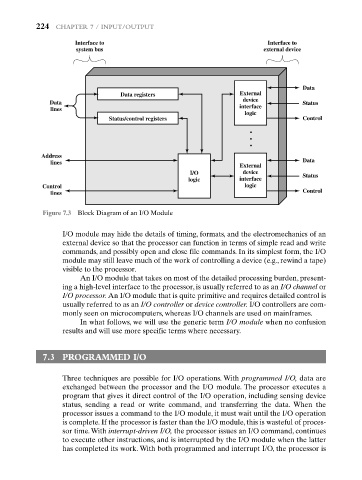
             Figure 7.3 Block Diagram of an I/O Module


                  I/O module may hide the details of timing, formats, and the electromechanics of an
                  external device so that the processor can function in terms of simple read and write
                  commands, and possibly open and close file commands. In its simplest form, the I/O
                  module may still leave much of the work of controlling a device (e.g., rewind a tape)
                  visible to the processor.
                       An I/O module that takes on most of the detailed processing burden, present-
                  ing a high-level interface to the processor, is usually referred to as an I/O channel or
                  I/O processor. An I/O module that is quite primitive and requires detailed control is
                  usually referred to as an I/O controller or device controller. I/O controllers are com-
                  monly seen on microcomputers, whereas I/O channels are used on mainframes.
                       In what follows, we will use the generic term I/O module when no confusion
                  results and will use more specific terms where necessary.


             7.3 PROGRAMMED I/O


                  Three techniques are possible for I/O operations. With programmed I/O, data are
                  exchanged between the processor and the I/O module. The processor executes a
                  program that gives it direct control of the I/O operation, including sensing device
                  status, sending a read or write command, and transferring the data. When the
                  processor issues a command to the I/O module, it must wait until the I/O operation
                  is complete. If the processor is faster than the I/O module, this is wasteful of proces-
                  sor time.With interrupt-driven I/O, the processor issues an I/O command, continues
                  to execute other instructions, and is interrupted by the I/O module when the latter
                  has completed its work. With both programmed and interrupt I/O, the processor is

