


Page 260 -
P. 260
7.3 / PROGRAMMED I/O 227

                       When the processor, main memory, and I/O share a common bus, two modes
                  of addressing are possible: memory mapped and isolated. With memory-mapped
                  I/O, there is a single address space for memory locations and I/O devices. The
                  processor treats the status and data registers of I/O modules as memory locations
                  and uses the same machine instructions to access both memory and I/O devices. So,
                  for example, with 10 address lines, a combined total of 2 10  =  1024 memory locations
                  and I/O addresses can be supported, in any combination.
                       With memory-mapped I/O, a single read line and a single write line are needed
                  on the bus.Alternatively, the bus may be equipped with memory read and write plus
                  input and output command lines. Now, the command line specifies whether the ad-
                  dress refers to a memory location or an I/O device. The full range of addresses may
                  be available for both.Again, with 10 address lines, the system may now support both
                  1024 memory locations and 1024 I/O addresses. Because the address space for I/O is
                  isolated from that for memory, this is referred to as isolated I/O.
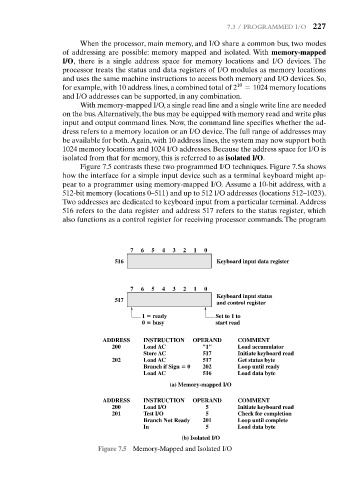
                       Figure 7.5 contrasts these two programmed I/O techniques. Figure 7.5a shows
                  how the interface for a simple input device such as a terminal keyboard might ap-
                  pear to a programmer using memory-mapped I/O. Assume a 10-bit address, with a
                  512-bit memory (locations 0–511) and up to 512 I/O addresses (locations 512–1023).
                  Two addresses are dedicated to keyboard input from a particular terminal.Address
                  516 refers to the data register and address 517 refers to the status register, which
                  also functions as a control register for receiving processor commands. The program


                                     7  6  5  4  3  2  1  0
                                516                         Keyboard input data register


                                     7  6  5  4  3  2  1  0
                                                            Keyboard input status
                                517
                                                            and control register
                                        1   ready           Set to 1 to
                                        0   busy            start read

                             ADDRESS    INSTRUCTION   OPERAND     COMMENT
                                200     Load AC         "1"       Load accumulator
                                        Store AC        517       Initiate keyboard read
                                202     Load AC         517       Get status byte
                                        Branch if Sign   0   202   Loop until ready
                                        Load AC         516       Load data byte
                                               (a) Memory-mapped I/O

                             ADDRESS    INSTRUCTION   OPERAND     COMMENT
                                200     Load I/O         5        Initiate keyboard read
                                201     Test I/O         5        Check for completion
                                        Branch Not Ready   201    Loop until complete
                                        In               5        Load data byte
                                                   (b) Isolated I/O
                            Figure 7.5 Memory-Mapped and Isolated I/O

