


Page 259 -
P. 259
226  CHAPTER 7 / INPUT/OUTPUT

               Issue read                Issue read  CPU     I/O  Issue read  CPU     DMA
               command to  CPU     I/O   command to    Do something  block command  Do something
               I/O module                I/O module    else       to I/O module  else

               Read status               Read status   Interrupt  Read status   Interrupt
               of I/O    I/O     CPU     of I/O                   of DMA
               module                    module    I/O     CPU    module    DMA     CPU
             Not
             ready                                               Next instruction
                 Check     Error          Check      Error
                 Status    Condition       status    condition  (c) Direct Memory Access
              Ready                     Ready
               Read word                 Read word
               from I/O  I/O     CPU     from I/O  I/O     CPU
               module                    module


               Write word                Write word
               into memory  CPU     Memory  into memory  CPU     Memory


            No                        No
                 Done?                     Done?
                Yes                      Yes
              Next instruction         Next instruction
             (a) Programmed I/O       (b) Interrupt-Driven I/O
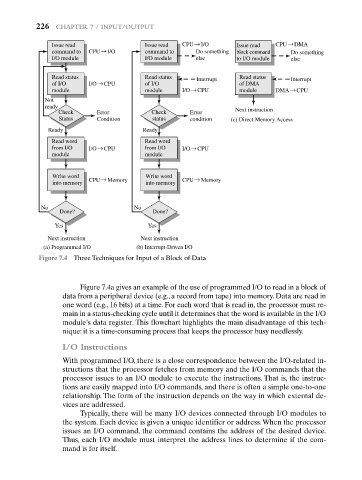
            Figure 7.4  Three Techniques for Input of a Block of Data


                       Figure 7.4a gives an example of the use of programmed I/O to read in a block of
                  data from a peripheral device (e.g., a record from tape) into memory. Data are read in
                  one word (e.g., 16 bits) at a time. For each word that is read in, the processor must re-
                  main in a status-checking cycle until it determines that the word is available in the I/O
                  module’s data register. This flowchart highlights the main disadvantage of this tech-
                  nique: it is a time-consuming process that keeps the processor busy needlessly.

                  I/O Instructions
                  With programmed I/O, there is a close correspondence between the I/O-related in-
                  structions that the processor fetches from memory and the I/O commands that the
                  processor issues to an I/O module to execute the instructions. That is, the instruc-
                  tions are easily mapped into I/O commands, and there is often a simple one-to-one
                  relationship. The form of the instruction depends on the way in which external de-
                  vices are addressed.
                       Typically, there will be many I/O devices connected through I/O modules to
                  the system. Each device is given a unique identifier or address. When the processor
                  issues an I/O command, the command contains the address of the desired device.
                  Thus, each I/O module must interpret the address lines to determine if the com-
                  mand is for itself.

