


Page 426 -
P. 426
Section 13.1  Elements of Differential Geometry  394


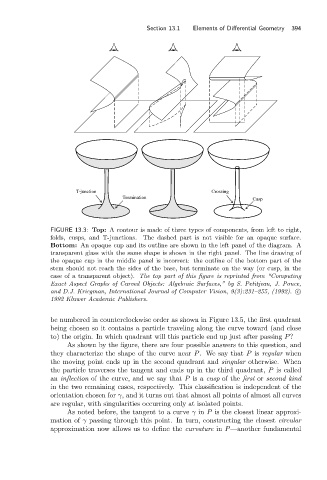
                            FIGURE 13.3: Top: A contour is made of three types of components, from left to right,
                            folds, cusps, and T-junctions. The dashed part is not visible for an opaque surface.
                            Bottom: An opaque cup and its outline are shown in the left panel of the diagram. A
                            transparent glass with the same shape is shown in the right panel. The line drawing of
                            the opaque cup in the middle panel is incorrect: the outline of the bottom part of the
                            stem should not reach the sides of the base, but terminate on the way (or cusp, in the
                            case of a transparent object). The top part of this figure is reprinted from “Computing
                            Exact Aspect Graphs of Curved Objects: Algebraic Surfaces,” by S. Petitjean, J. Ponce,
                            and D.J. Kriegman, International Journal of Computer Vision, 9(3):231–255, (1992). c
                            1992 Kluwer Academic Publishers.

                            be numbered in counterclockwise order as shown in Figure 13.5, the first quadrant
                            being chosen so it contains a particle traveling along the curve toward (and close
                            to) the origin. In which quadrant will this particle end up just after passing P?
                                 As shown by the figure, there are four possible answers to this question, and
                            they characterize the shape of the curve near P.We say that P is regular when
                            the moving point ends up in the second quadrant and singular otherwise. When
                            the particle traverses the tangent and ends up in the third quadrant, P is called
                            an inflection of the curve, and we say that P is a cusp of the first or second kind
                            in the two remaining cases, respectively. This classification is independent of the
                            orientation chosen for γ, and it turns out that almost all points of almost all curves
                            are regular, with singularities occurring only at isolated points.
                                 As noted before, the tangent to a curve γ in P is the closest linear approxi-
                            mation of γ passing through this point. In turn, constructing the closest circular
                            approximation now allows us to define the curvature in P—another fundamental

