


Page 507 - Construction Waterproofing Handbook
P. 507
SAFETY  14.5


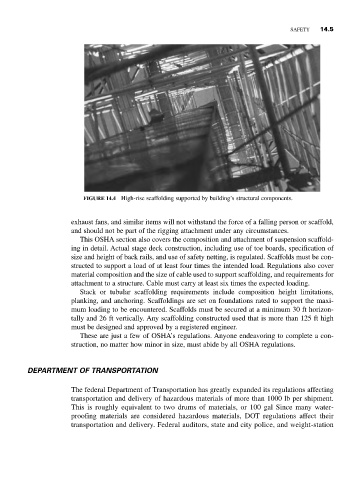
                             FIGURE 14.4 High-rise scaffolding supported by building’s structural components.


                         exhaust fans, and similar items will not withstand the force of a falling person or scaffold,
                         and should not be part of the rigging attachment under any circumstances.
                            This OSHA section also covers the composition and attachment of suspension scaffold-
                         ing in detail. Actual stage deck construction, including use of toe boards, specification of
                         size and height of back rails, and use of safety netting, is regulated. Scaffolds must be con-
                         structed to support a load of at least four times the intended load. Regulations also cover
                         material composition and the size of cable used to support scaffolding, and requirements for
                         attachment to a structure. Cable must carry at least six times the expected loading.
                            Stack or tubular scaffolding requirements include composition height limitations,
                         planking, and anchoring. Scaffoldings are set on foundations rated to support the maxi-
                         mum loading to be encountered. Scaffolds must be secured at a minimum 30 ft horizon-
                         tally and 26 ft vertically. Any scaffolding constructed used that is more than 125 ft high
                         must be designed and approved by a registered engineer.
                            These are just a few of OSHA’s regulations. Anyone endeavoring to complete a con-
                         struction, no matter how minor in size, must abide by all OSHA regulations.


             DEPARTMENT OF TRANSPORTATION

                         The federal Department of Transportation has greatly expanded its regulations affecting
                         transportation and delivery of hazardous materials of more than 1000 lb per shipment.
                         This is roughly equivalent to two drums of materials, or 100 gal Since many water-
                         proofing materials are considered hazardous materials, DOT regulations affect  their
                         transportation and delivery. Federal auditors, state and city police, and weight-station

