


Page 589 - Corrosion Engineering Principles and Practice
P. 589
552    C h a p t e r   1 3                                                                                                        C a t h o d i c   P r o t e c t i o n    553


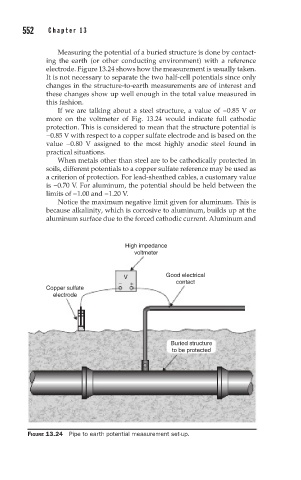
                         Measuring the potential of a buried structure is done by contact-
                      ing  the  earth  (or  other  conducting  environment)  with  a  reference
                      electrode. Figure 13.24 shows how the measurement is usually taken.
                      It is not necessary to separate the two half-cell potentials since only
                      changes in the structure-to-earth measurements are of interest and
                      these changes show up well enough in the total value measured in
                      this fashion.
                         If we are talking about a steel structure, a value of −0.85 V or
                      more  on  the  voltmeter  of  Fig.  13.24  would  indicate  full  cathodic
                      protection. This is considered to mean that the structure potential is
                      −0.85 V with respect to a copper sulfate electrode and is based on the
                      value  −0.80  V  assigned  to  the  most  highly  anodic  steel  found  in
                      practical situations.
                         When metals other than steel are to be cathodically protected in
                      soils, different potentials to a copper sulfate reference may be used as
                      a criterion of protection. For lead-sheathed cables, a customary value
                      is −0.70 V. For aluminum, the potential should be held between the
                      limits of −1.00 and −1.20 V.
                         Notice the maximum negative limit given for aluminum. This is
                      because alkalinity, which is corrosive to aluminum, builds up at the
                      aluminum surface due to the forced cathodic current. Aluminum and


                                            High impedance
                                              voltmeter


                                           V           Good electrical
                                          –  +            contact
                      Copper sulfate
                        electrode


                                                        Buried structure
                                                         to be protected


                 FIGURE 13.24  Pipe to earth potential measurement set-up.

