


Page 584 - Corrosion Engineering Principles and Practice
P. 584
546   C h a p t e r   1 3                              C a t h o d i c   P r o t e c t i o n    547


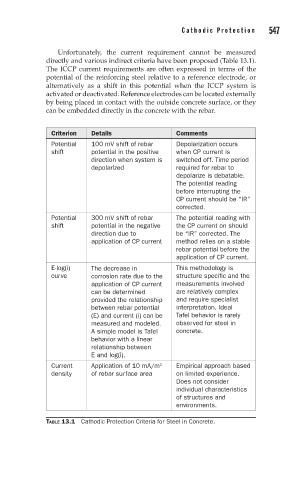
                         Unfortunately,  the  current  requirement  cannot  be  measured
                      directly and various indirect criteria have been proposed (Table 13.1).
                      The ICCP current requirements are often expressed in terms of the
                      potential of the reinforcing steel relative to a reference electrode, or
                      alternatively  as  a  shift  in  this  potential  when  the  ICCP  system  is
                      activated or deactivated. Reference electrodes can be located externally
                      by being placed in contact with the outside concrete surface, or they
                      can be embedded directly in the concrete with the rebar.


                       Criterion  Details                 Comments
                       Potential   100 mV shift of rebar   Depolarization occurs
                       shift      potential in the positive   when CP current is
                                  direction when system is   switched off. Time period
                                  depolarized             required for rebar to
                                                          depolarize is debatable.
                                                          The potential reading
                                                          before interrupting the
                                                          CP current should be “IR”
                                                          corrected.
                       Potential   300 mV shift of rebar   The potential reading with
                       shift      potential in the negative   the CP current on should
                                  direction due to        be “IR” corrected. The
                                  application of CP current  method relies on a stable
                                                          rebar potential before the
                                                          application of CP current.
                       E-log(i)   The decrease in         This methodology is
                       curve      corrosion rate due to the   structure specific and the
                                  application of CP current   measurements involved
                                  can be determined       are relatively complex
                                  provided the relationship   and require specialist
                                  between rebar potential   interpretation. Ideal
                                  (E) and current (i) can be   Tafel behavior is rarely
                                  measured and modeled.   observed for steel in
                                  A simple model is Tafel   concrete.
                                  behavior with a linear
                                  relationship between
                                  E and log(i).
                                                     2
                       Current    Application of 10 mA/m    Empirical approach based
                       density    of rebar surface area   on limited experience.
                                                          Does not consider
                                                          individual characteristics
                                                          of structures and
                                                          environments.

                      TABLE 13.1  Cathodic Protection Criteria for Steel in Concrete.

