


Page 583 - Corrosion Engineering Principles and Practice
P. 583
546     C h a p t e r   1 3                                                                                                        C a t h o d i c   P r o t e c t i o n    547


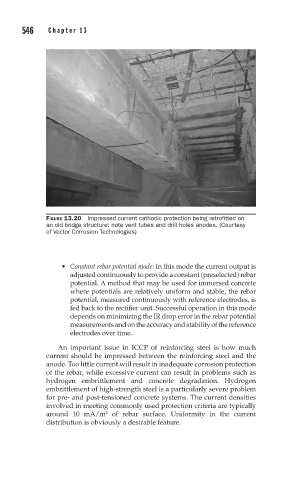
                      FIGURE 13.20  Impressed current cathodic protection being retrofitted on
                      an old bridge structure: note vent tubes and drill holes anodes. (Courtesy
                      of Vector Corrosion Technologies)


                          •  Constant rebar potential mode: In this mode the current output is
                             adjusted continuously to provide a constant (preselected) rebar
                             potential. A method that may be used for immersed concrete
                             where potentials are relatively uniform and stable, the rebar
                             potential, measured continuously with reference electrodes, is
                             fed back to the rectifier unit. Successful operation in this mode
                             depends on minimizing the IR drop error in the rebar potential
                             measurements and on the accuracy and stability of the reference
                             electrodes over time.

                         An  important  issue  in  ICCP  of  reinforcing  steel  is  how  much
                      current should be impressed between the reinforcing steel and the
                      anode. Too little current will result in inadequate corrosion protection
                      of the rebar, while excessive current can result in problems such as
                      hydrogen  embrittlement  and  concrete  degradation.  Hydrogen
                      embrittlement of high-strength steel is a particularly severe problem
                      for pre- and post-tensioned concrete systems. The current densities
                      involved in meeting commonly used protection criteria are typically
                      around  10  mA/m   of  rebar  surface.  Uniformity  in  the  current
                                      2
                      distribution is obviously a desirable feature.

