


Page 585 - Corrosion Engineering Principles and Practice
P. 585
548     C h a p t e r   1 3                                                                                                        C a t h o d i c   P r o t e c t i o n    549


                      13.4.2  Sacrificial Cathodic Protection
                      One  alternative  to  impressed  current  CP  is  galvanic  or  sacrificial
                      anode CP. For steel in concrete, sacrificial anodes are typically made
                      of zinc or a zinc based alloy. While ICCP systems have been widely
                      used since the 1980s, sacrificial CP systems have only become available
                      around the end of the 1990s. Various configurations exist, including
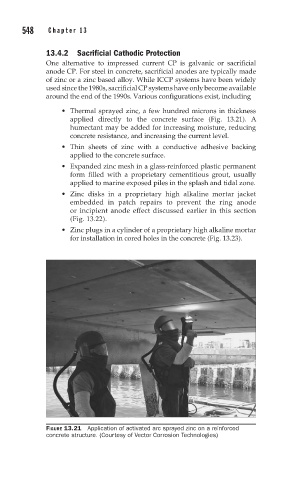
                          •  Thermal sprayed zinc, a few hundred microns in thickness
                             applied  directly  to  the  concrete  surface  (Fig.  13.21).  A
                             humectant may be added for increasing moisture, reducing
                             concrete resistance, and increasing the current level.
                          •  Thin  sheets  of  zinc  with  a  conductive  adhesive  backing
                             applied to the concrete surface.
                          •  Expanded zinc mesh in a glass-reinforced plastic permanent
                             form  filled  with  a  proprietary  cementitious  grout,  usually
                             applied to marine exposed piles in the splash and tidal zone.
                          •  Zinc  disks  in  a  proprietary  high  alkaline  mortar  jacket
                             embedded  in  patch  repairs  to  prevent  the  ring  anode
                             or incipient anode effect discussed earlier in this section
                             (Fig. 13.22).
                          •  Zinc plugs in a cylinder of a proprietary high alkaline mortar
                             for installation in cored holes in the concrete (Fig. 13.23).


                      FIGURE 13.21  Application of activated arc sprayed zinc on a reinforced
                      concrete structure. (Courtesy of Vector Corrosion Technologies)

