


Page 163 - Crisis Communication Practical PR Strategies
P. 163
4
             4
            1 144 Crisis Communication
            trained them but were never able to get near him. Consequently he
            floundered and appeared out of touch and distinctly ‘off-message’ at a
            press conference during a crisis. He left the company shortly afterwards.
              According to the Harvard Business Review, ‘most companies do an
            inadequate job of managing their reputations in general and the risks
            to their reputations in particular’. Any CEO or board should be aware
            of the vital need for crisis training. Research, for instance that con-
            ducted by Oxford Metrica, underlines that the fortunes of a company
            or organization during and following a corporate crisis, for better or –
            more commonly – for worse, depend upon the perceived competence
            of the board in dealing with it. Further research has shown that it can
            take years for a company’s share price to recover fully after a crisis if it
            is believed that it was handled badly.


                                 Getting it right


            The textbook example of how to respond to a crisis was given by Sir
            Michael Bishop, British Midland’s chairman, in 1989 after one of his
            aircraft crashed near the M1 motorway in the Midlands, killing 47
            people and injuring 74.
              Bishop went immediately to the scene, took responsibility and per-
            sonally dealt with the media in an open and honest manner. He was
            reassuring and authoritative, so much so that the crash became known
            as the Kegworth (where the plane crashed) rather than British
            Midland, disaster.


                Activity            Crisis activity


                                                   Effective crisis
                                                   management activity


                                                             Time
             Crisis identified
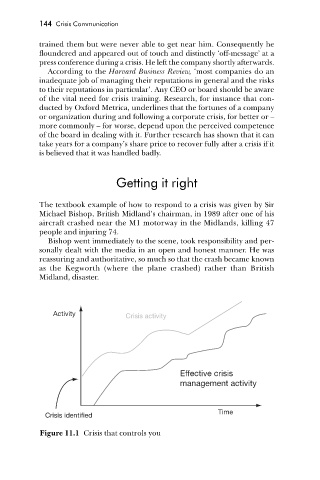
            Figure 11.1 Crisis that controls you

