


Page 164 - Crisis Communication Practical PR Strategies
P. 164
4
                                                                           1
                                                                             5
                                How Senior Management Can Make the Crisis Worse 145
              By acting so decisively Bishop revealed an impressive understanding
              of how to lead during a crisis and when under intense media scrutiny.
              He was always available, open, sympathetic and helpful. Despite the
              enormity of the disaster (caused by mechanical failure and pilot error),
              the public did not lose their trust in British Midland.
                Contrast that with the damage done to turkey farmer Bernard
              Matthews, one of the UK food industry’s best known brands. It suf-
              fered an outbreak of the bird flu virus H5N1 at a turkey farm in
              Norfolk in early 2007. Despite reassurances, journalists kept revealing
              information that the company should have been releasing.
                Mr Matthews did not adopt the Sir Michael Bishop approach. Sales
              slumped due to a loss of public confidence – particularly after the
              source of the virus was revealed to be turkey meat imported from a
              sister factory in Hungary. This story is more likely to become a text-
              book study for all the wrong reasons.
                As Gary Davies, Manchester Business School’s Professor of
              Corporate Reputation, says (contrary to the advice you will get from
              many corporate lawyers) the best way to protect and perhaps save
              your business’s shaky reputation in a crisis is to: ‘get the boss out front,
              apologize for your mistakes and take the hit’.
                Companies quoted on the London Stock Exchange are now obliged
              to have strong risk management strategies in place and to report these
              to shareholders. A common approach is to generate a risk register and
              to develop business continuity, communication and security plans.
              Such plans are, however, often not united under effective board own-


                               Effective crisis
                               management activity

                  Activity


                                          Crisis activity


                                                                Time
                Crisis identified
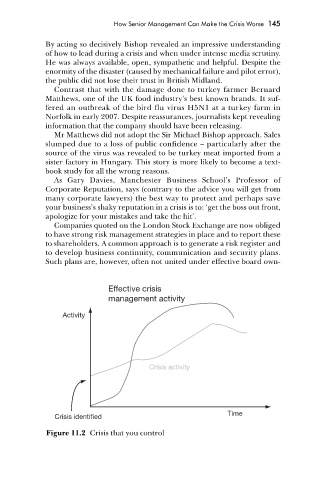
              Figure 11.2 Crisis that you control

