


Page 105 - Curvature and Homology
P. 105
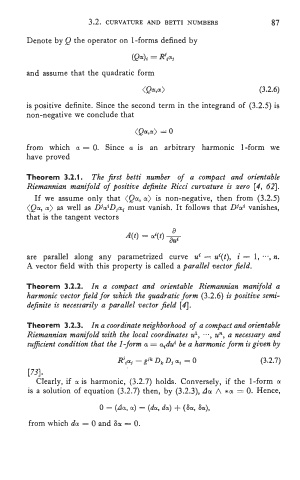
Denote by Q the operator on 1-forms defined by


       and  assume that the quadratic form


       is positive definite. Since the second term in the integrand of  (3.2.5) is
       non-negative we conclude that


       from  which  a = 0. Since  a  is  an  arbitrary  harmonic  1-form  we
       have proved

       Theorem  3.2.1.   The first  betti  number  of  a  compact  and  orientable
       Riemannian  manifold of  positive  definite Ricci  curvature  is zero  [4, 621.
         If  we  assume only  that  (Qa,  a)  is  non-negative,  then  from  (3.2.5)
        (Qa,  a)  as well  as DjaiDjai must  vanish. It follows that Djai vanishes,
       that is the tangent vectors


        are  parallel  along  any  parametrized  curve  ui  = uC(t), i = 1, a*.,  n.
        A vector field with this property  is called a parallel  vector field.
       Theorem  3.2.2.   In  a  compact  and  orientable  Riemannian  manfold  a
        harmonic vector field for  which the quadratic form  (3.2.6)  is positive  semi-
        definite is necessarily a parallel  vector field  [q.

        Theorem  3.2.3.  In a coordinate n&ghborhood  of  a compact and mientable
        Riemannian manvold with the local coordinates ul,  ..a,  un, a necessary and
        suflcient condition that the 1-form a = aiduf be a harmonic form is given by

                             Piai - gfk Dk D, ai = 0            (3.2.7)
        1731
          Clearly, if  a is  harmonic,  (3.2.7)  holds.  Conversely, if  the  1-form a
        is a solution of  equation (3.2.7)  then,  by (3.2.3), Aa A  +a = 0. Hence,

                         0 = (Aa, a) = (da, da) + (Sa, Sa),
        from which da = 0 and 6a = 0.

