


Page 118 - Curvature and Homology
P. 118
100     111.  RIEMANNIAN  MANIFOLDS:  CURVATURE,  HOMOLOGY

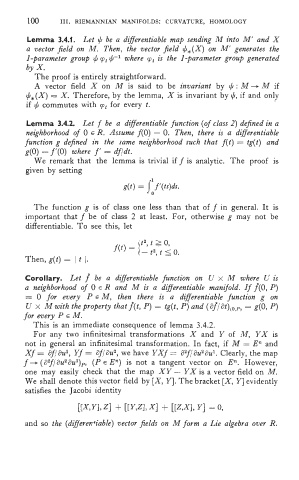
        Lemma 3.4.1.   Let  $ be  a  dzflerentiable map sending  M  into M' and  X
       a  vector field  on  M.  Then,  the  vector field  $,(X)  on  M'  generates  the
       I-parameter  group  $ y, $-l  where  yt is  the  I-parameter  group generated
       by x.
         The proof  is entirely straightforward.
         A  vector  field  X  on  M  is  said  to  be  invariant  by + : M  + M  if
       $,(X) = X.  Therefore, by the lemma,  X  is invariant by $, if  and only
       if  $ commutes with cp,  for every  t.

       Lemma 3.4.2.   Let  f  be  a  dzrerentiable function  (of class 2) defined in a
       neighborhood  of  0  E R.  Assume f(0) = 0.  Then,  there  is  a  dzrerentiable
       function  g  defined  in  the  same  neQhborhood  such  that  f(t) = tg(t) and
       g(0) = f'(0)  where  f'  = df/dt.
         We remark  that  the  lemma  is trivial  iff  is analytic.  The  proof  is
       given  by setting

                               g(t) =   '(ts)dr.
                                     0
         The function g is  of  class  one  less  than  that  off  in  general.  It  is
       important that f be  of  class  2  at  least.  For,  otherwise g  may  not  be
       differentiable.  To see this,  let

                            f(')  = 1  t2, t 2 0,
       Then, g(t) = I  t  1.       - t2, t 5 0.

       Corollary.  Let  f  be  a  dzrerentiable function  on  U  x  M  where  U is
       a  neighborhood  of  0  E R  and  M  is  a  d~flerentiable manifold.  If  f(0, P)
       = 0  for  every  P  E M,  then  there  is  a  dz;f)cerentiable function  g  on
       U x  M with the property that f(t, P) = tg(t, P) and (af /at),,,p, = g(0, P)
       for  every P  E M.
         This is an immediate  consequence of  lemma 3.4.2.
         For  any  two  infinitesimal transformations  X  and  Y  of  M,  YX is
       not  in general  an infinitesimal  transformation. In fact,  if  M = En  and
       Xf  = af/aul, Yf = af/au2, we have YXf ==  a2f/au2au1. Clearly, the map
       f  -+ (a2f/au2&&   (P E En)  is  not  a  tangent  vector  on  En.  However,
       one  may  easily  check  that  the  map  XY - YX is a vector field on M.
       We shall denote this vector field by [X, Y]. The bracket [X, Y] evidently
       satisfies the  Jacobi  identity


       and so the (diflerentiable) vector Jields on M form  a Lie  algebra  over  R.

