


Page 123 - Curvature and Homology
P. 123
(ii)  The point  P. a = R,  P,  P EM depends  differentiably on  a E G
        and P where Ra P = Ra (P).
          Clearly, Re is the identity transformation  of  M.  Hence, Ra(Ra-I(P))
        = P for every a E G and P E M.  The group G is said to act effectively
        if  Ra P = P for  every P E M  implies a = e.
          Let A be an element of the Lie algebra L of  G and a, the 1-parameter
        subgroup of  G generated by  A.  A is a left invariant infinitesimal trans-
        formation  of  G.  The  corresponding  1-parameter  group  of  trans-
        formations  Rat on  M  induces  a  differentiable vector  field  A*  on  M.
        Let  a  denote  the  map  sending  A EL to A* EL* (the  Lie  algebra of
        differentiable vector  fields on  M).

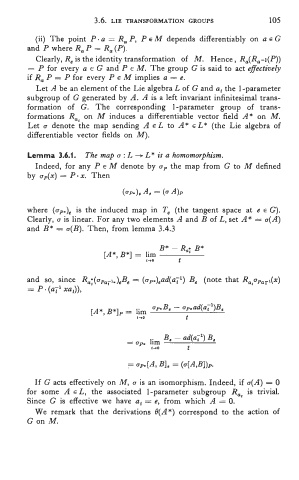
        Lemma 3.6.1.   The map a : L -+ L* is a homomorphism.
          Indeed, for  any P E M  denote by  a,  the map from  G to M defined
        by  U~X)  x.  Then
               = P


        where      is  the  induced  map  in  T, (the  tangent  space  at  e E G).
        Clearly, a is linear.  For any two elements A and B of L, set A* = o(A)
        and B* = o(B).  Then, from lemma 3.4.3

                                       B* - R,; B*
                          [A*, B*]  = lim
                                    t-ro    t


                                      u+B,  - ~p.ad(a;-~)B,
                       [A*, B*Ip = lim
                                  t+O         t
                                        B,  - ad(ayl) B,
                                = a+  lim
                                     t-ro     t


         If  G acts effectively on M, a is an isomorphism. Indeed,  if  4A) = 0
        for  some  A EL, the  associated  1-parameter  subgroup  Rag is  trivial.
        Since  G  is  effective we  have  a, = e,  from  which  A  = 0.
         We  remark  that  the  derivations O(A*)  correspond  to  the  action  of
        G on M.

