


Page 127 - Curvature and Homology
P. 127
3.7.  CONFORMAL  TRANSFORMATIONS          109
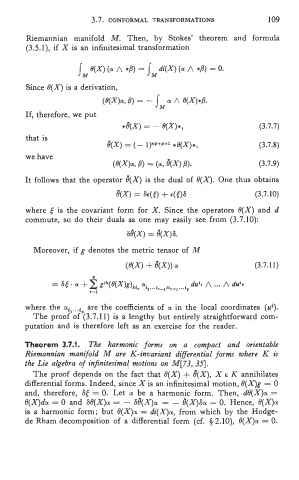
       Riemannian  manifold  M.  Then,  by  Stokes'  theorem  and  formula
       (3.5.1),  if  X  is an infinitesimal transformation


       Since B(X) is a derivation,


       If, therefore, we put
                              *&x) = - B(x)*,
       that is


       It follows that the operator &X) is the dual of  B(X). One thus obtains


       where 5 is the covariant form  for  X.  Since the operators  B(X) and  d
       commute,  so do their  duals as one may  easily see from  (3.7.10):


         Moreover, if g denotes the metric tensor of  M


       where the      are the coefficients of  or  in the  local coordinates  (ui).
         The proof  of  (3.7.11)  is a lengthy but  entiiely straightforward  com-
       putation  and  is therefore  left as an exercise for the reader.

       Theorem 3.7.1.   The  harmonic  forms  on  a  compact  and  orientable
       Riemannian  manifold  M  are  K-invariant  diferential forms  where  K  is
       the Lie algebra of  infinitesimal motions on  M[73,35].
         The proof  depends on the fact that  B(X) + B(X), X  E K  annihilates
       differential forms. Indeed, since X is an infinitesimal motion, B(X)g  = 0
       and,  therefore,  65 = 0.  Let  a  be  a  harmonic  form.  Then,  dB(X)a =
       B(X)da = 0  and  SB(X)a = - SB(X)a  = - B(X)Sa = 0.  Hence,  B(X)a
       is a harmonic  form;  but  B(X)a = di(X)a,  from  which  by  the  Hodge-
       de Rham decomposition of  a  differential form  (cf.  5 2.10),  B(X)a  = 0.

