


Page 130 - Curvature and Homology
P. 130
112     111.  RIEMANNIAN MANIFOLDS: CURVATURE,  HOMOLOGY
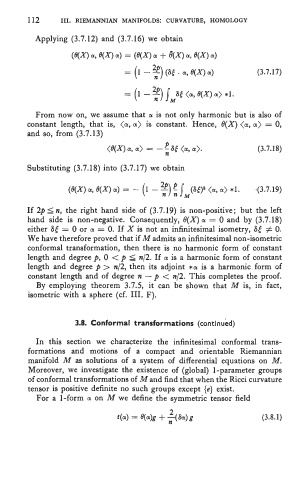
          Applying (3.7.12)  and (3.7.16)  we  obtain


                                      :)
                               = (1 -  jM8f (a, e(x) a) $1.

          From now on, we  assume that a is not only harmonic but is also of
        constant  length,  that  is,  (a, a) is  constant.  Hence,  B(X) (a, a)  = 0,
        and so, from (3.7.13)
                           <o(x) a, a)  = - P-- 6~ (a, a).     (3.7.18)
                                         n
        Substituting (3.7.18)  into (3.7.17)  we  obtain


        If 2p 5 n,  the right  hand  side of  (3.7.19)  is non-positive;  but  the left
        hand  side  is  non-negative.  Consequently, B(X) a = 0 and by  (3.7.18)
        either 86 = 0 or a = 0. If X is not an infinitesimal isometry, 86 # 0.
        We have therefore proved that if M admits an infinitesimal non-isometric
        conformal transformation,  then there is no harmonic  form of  constant
        length and degree p, 0  < p 5 42. If  a is a harmonic form of  constant
        length and  degree p > n/2, then its adjoint  *a is a  harmonic form of
        constant length and of  degree n - p  < 42. This completes the proof.
          By employing  theorem  3.7.5,  it  can  be shown  that  M is,  in  fact,
        isometric with  a sphere (cf. 111. F).


                   3.8.  Conformal transformations (contin ukd)

          In  this  section  we  characterize  the  infinitesimal  conformal  trans-
        formations  and  motions  of  a  compact  and  orientable  Riemannian
        manifold  M as  solutions of  a  system  of  differential equations  on  M.
        Moreover, we investigate the existence of  (global) 1-parameter groups
        of conformal transformations of M and find that when the Ricci curvature
        tensor is positive definite no such groups except {e}  exist.
          For a l-form  a on M we  define the symmetric tensor  field

