


Page 119 - Curvature and Homology
P. 119
3.5.  THE  DERIVATION  6(X)            101

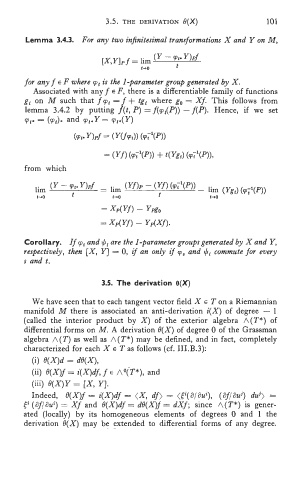
       Lemma 3.4.3.   For any two infinitesimal tran.fo~mations X and Y on M,

                                 = lim
                                   t+O
       for  any f E F where tpt is the 1 -parameter group generated by  X.
         Associated with any f E F, there is a differentiable family of functions
       g,  on  M  such  that f tp,  = f + tg,  where  go = Xf.  This follows  from
       lemma  3.4.2  by  putting f(t,  P) = f(tp,(P))  - f(P).  Hence,  if  we  set
       0)t'  = (tpt)* and tpt*Y=  tpt*(Y)


       Corollary.  If qt and $I are the I-parameter groups generated by X and Y,
       respectively,  then  [X, Y] = 0, if an only  if  tp,  and $,  commute fm  every
       s and t.

                         3.5.  The derivation B(X)

         We have seen that to each tangent vector field X E T on a Riemannian
       manifold  M  there  is  associated  an anti-derivation  i(X)  of  degree  - 1
       (called  the  interior  product  by  X) of  the  exterior  algebra  A(T*)  of
       differential forms on M. A derivation B(X) of  degree 0 of the Grassman
       algebra  A(T) as well as  A(T*) may  be defined,  and in fact,  completely
       characterized for each X E T as follows (cf. III.B.3):
         (i)  8(X)d = de(X),
         (ii)  6(X)f  = i(X)df, f E EAT*),  and
         (iii)  6(X)  Y = [X, Y].
         Indeed,  6(X)f  = i(X)df  = (X,  df)  = @(a/ aui),  (aflauj)  du*)  =
         ( af/ aui) = Xf  and  6(X)df  = dB(X)f  = dXf;  since  A (T*) is  gener-
       ated  (locally)  by  its  homogeneous  elements  of  degrees  0  and  1  the
       derivation  6(X)  may  be  extended to  differential forms of  any  degree.

