


Page 143 - Curvature and Homology
P. 143
EXERCISES

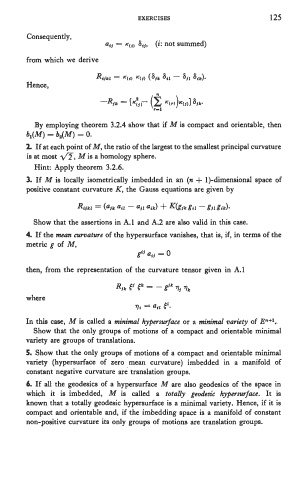
       Consequently,
                          au = K(~) &,,   (i: not summed)

       from which we  derive


         By  employing theorem 3.2.4  show that if  M is compact and orientable, then
       bl(M) = bdM) = 0.
       2.  If at each point of M, the ratio of the largest to the smallest principal curvature
       is at most a, M is a homology sphere.
         Hint:  Apply theorem 3.2.6.
       3.  If M  is locally isometrically imbedded in an (n + 1)-dimensional space of
       positive constant curvature K, the Gauss equations are given by


         Show that the assertions in A.l  and A.2  are also valid in this case.
       4.  If the mean curoatwe of the hypersurface vanishes, that is, if, in terms of the
       metric g of  M,
                                  gZj a,  = 0
       then, from the representation of  the curvature tensor given in A.1


       where


       In this case,  M is called a minimal hypersurface or a minimal variety of  @+I,
         Show that the only groups of  motions of  a compact and orientable minimal
       variety are groups of  translations.
       5.  Show that the only groups of  motions of  a compact and orientable minimal
       variety  (hypersurface  of  zero  mean  curvature)  imbedded  in  a  manifold  of
       constant negative curvature are translation groups.
       6.  If all the geodesics of  a hypersurface M are also geodesics of  the space in
       which  it  is imbedded,  M  is  called  a  totally  gcodwic  hyperwface.  It  is
       known that a totally geodesic hypersurface is a minimal variety.  Hence, if it is
       compact and orientable and, if  the imbedding space is a manifold of  constant
       non-positive  curvature its only groups of  motions are translation groups.

