


Page 145 - Curvature and Homology
P. 145
EXERCISES                       127

       space at P(t) = exp(tX)P.  The induced  dual  map  exp(tX)*  sends  A(T&)
       into A (T;). For an element   E /\"(Tp*,t,)


       is an element of  AP(T,*).  Show that


       and that consequently


       for any elements a, B E A *(T).
         Hint: Show that


       C.  Frobenius' theorem and  infinitesimal transformations
       1.  Show that the conditions in Frobenius theorem  (I.  D.4)  may  be  expressed
       in the following form: If the basis of the tangent space Tp at P E M is chosen
       so  that  the subspace F(P) of  Tp  of  dimension r  is  spanned  by  the  vectors
       XA(A = q + 1, ... , n)  then,  if  we  take  8 = e1 A ... A 89  the  conditions of
       complete integrability are given by


         This is equivalent to the condition that  [XA,XB] is a linear  combination of
       Xu+,, .-. , X,  only. In other words,  F is completely integrable,  if  and only if,
       for any two infinitesimal transformations X,Y such that Xp,  Yp' E F(P) for all
       P E U the bracket [X, YIP E F(P).
       2.  Associated with the vector fields X and Y are the local one parameter groups
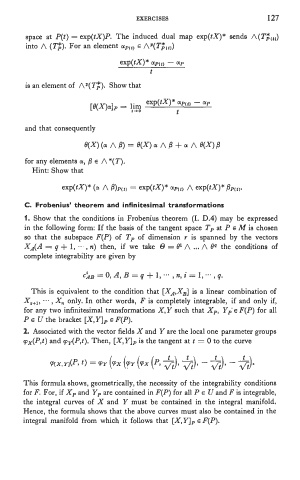
       vX(P,t) and vy(P,t).  Then, [X,YIP is the tangent at t = 0 to the curve
                                         t
                                              t
                                                     t
                                                            t
                                                          ?)
             WX. dP, t ) = vY (vx (?Y  (vx (p, T)9  z), 3),
                                                        -
                                                  -
       This formula shows, geometrically, the necessity of  the integrability conditions
       for F. For, if Xp and Yp are contained in F(P) for all P E U and F is integrable,
       the  integral curves of  X  and  Y must  be  contained in the integral manifold.
       Hence, the formula shows that the above curves must also be contained in the
       integral manifold from which it  follows that  [X,YJp E F(P).

