


Page 236 - Curvature and Homology
P. 236
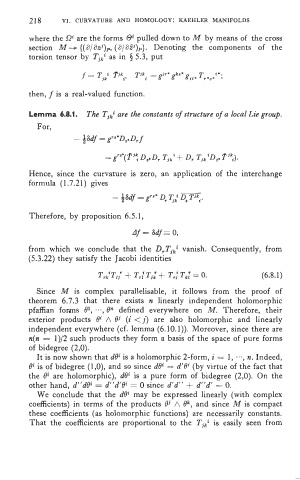
2 1 8   VI.  CURVATURE  AND  HOMOLOGY:  KAEHLER  MANIFOLDS
        where the Qi are the forms 6* pulled down to M  by means of  the cross
        section  M + {(ala~j)~, (a/aZj)p).  Denoting  the  components  of  the
        torsion tensor  by  Tfli  as in  5 5.3,  put


        then, f is a real-valued function.

        Lemma 6.8.1,   The Tjki are the constants of  structure of  a local Lie group.
          For,
                   - *Sdf  = gT8*D, D, f


        Hence,  since the  curvature  is zero,  an  application  of  the  interchange
        formula  (1.7.2 1) gives
                            - $Sdf  = grl'  D  T i D  Tjk
                                        r  jk   s   i'
        Therefore,  by proposition  6.5.1,
                                 Af  = Sdf  r 0,

        from  which  we  conclude  that  the  D,Tjki  vanish.  Consequently,  from
        (5.3.22)  they satisfy the Jacobi identities


          Since  M  is  complex  parallelisable,  it  follows  from  the  proof  of
        theorem  6.7.3  that  there  exists  n  linearly  independent  holomorphic
        pfaffian  forms  01,  .a*,  8n defined  everywhere  on  M.  Therefore,  their
        exterior  products  8"  A  Oj  (i < j)  are  also  holomorphic  and  linearly
        independent everywhere (cf. lemma (6.10.1)).  Moreover, since there are
        n(n - 1)/2 such products they form a basis of  the space of  pure forms
        of  bidegree (2,O).
          It is now shown that d8i is a holomorphic 2-form, i = 1, ..-, n. Indeed,
        8i is of  bidegree (1,0), and so since d8i  = d'Oi  (by virtue of  the fact that
        the 8i  are  holomorphic),  d8i  is  a  pure  form  of  bidegree  (2,O).  On  the
        other hand, dud@ = d"d'8i  = 0 since d'd"  + d"d'  = 0.
          We  conclude that  the  d8i  may  be  expressed  linearly (with  complex
        coefficients) in terms of  the products Oj A  Ok, and  since M is compact
        these  coefficients (as holomorphic  functions)  are  necessarily constants.
        That the  coefficients  are  proportional  to  the  Tjki is easily  seen  from

