


Page 237 - Curvature and Homology
P. 237
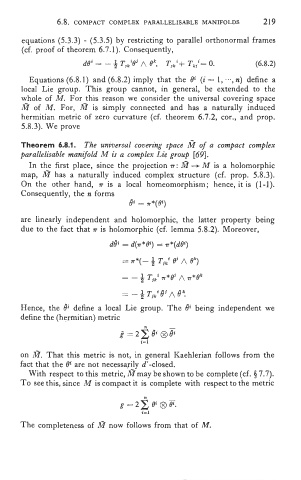
equations (5.3.3) - (5.3.5)  by  restricting to parallel  orthonormal frames
      (cf. proof of theorem 6.7.1). Consequently,


        Equations (6.8.1)  and (6.8.2)  imply  that  the  Bi  (i = 1, a*.,  n)  define  a
      local  Lie  group.  This  group  cannot,  in  general,  be  extended  to  the
      whole of  M.  For this reason  we  consider the universal  covering space
      A?  of  M.  For,  A?  is  simply  connected  and  has  a  naturally  induced
      hermitian  metric  of  zero  curvature (cf.  theorem  6.7.2,  cor.,  and  prop.
      5.8.3).  We prove

      Theorem  6.8.1.   The  universd  covering space  M of  a  compact  complex
      parallelisable manifold M is a  complex Lie group  [69].
        In the first  place,  since  the  projection rr: i@ -t M is  a  holomorphic
      map,  i@  has  a  naturally  induced  complex  structure  (cf.  prop.  5.8.3).
      On  the  other  hand,  rr  is  a  local  homeomorphism;  hence, it is  (1-1).
      Consequently, the n forms
                                0'  = ,*(@)
      are  linearly  independent  and  holomorphic,  the  latter  property  being
      due to the fact thatrr is holomorphic (cf. lemma 5.8.2).  Moreover,
                           dB'  = d(,*@)  = w*(dOi)


      Hence,  the & define a local  Lie  group.  The BL being  independent  we
      define the (hepitian) metric


      on I@.  That this metric is not,  in general  Kaehlerian follows from the
      fact that the Bi are not necessarily df-closed.
        With respect to this metric, A? may be shown to be complete (cf. 5 7.7).
      To see this, since M is compact it is complete with  respect to the metric


      The completeness of fl now follows from that of  M.

