


Page 704 - Discrete Mathematics and Its Applications
P. 704
10.4 Connectivity  683


                                                        Sometimes the removal from a graph of a vertex and all incident edges produces a subgraph
                                                     with more connected components. Such vertices are called cut vertices (or articulation points).
                                                     The removal of a cut vertex from a connected graph produces a subgraph that is not connected.
                                                    Analogously, an edge whose removal produces a graph with more connected components than
                                                     in the original graph is called a cut edge or bridge. Note that in a graph representing a computer
                                                     network, a cut vertex and a cut edge represent an essential router and an essential link that cannot
                                                     fail for all computers to be able to communicate.


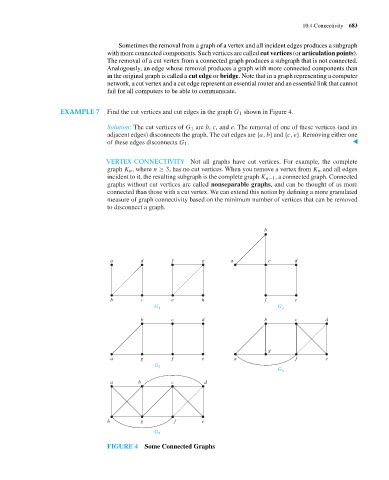
                                      EXAMPLE 7      Find the cut vertices and cut edges in the graph G 1 shown in Figure 4.

                                                     Solution: The cut vertices of G 1 are b, c, and e. The removal of one of these vertices (and its
                                                     adjacent edges) disconnects the graph. The cut edges are {a, b} and {c, e}. Removing either one
                                                     of these edges disconnects G 1 .                                               ▲


                                                    VERTEX CONNECTIVITY Not all graphs have cut vertices. For example, the complete
                                                     graph K n , where n ≥ 3, has no cut vertices. When you remove a vertex from K n and all edges
                                                     incident to it, the resulting subgraph is the complete graph K n−1 , a connected graph. Connected
                                                     graphs without cut vertices are called nonseparable graphs, and can be thought of as more
                                                     connected than those with a cut vertex. We can extend this notion by defining a more granulated
                                                     measure of graph connectivity based on the minimum number of vertices that can be removed
                                                     to disconnect a graph.


                                                                                                      b


                                                      a        d         f        g         a          c        d


                                                      b        c         e        h                   f         e
                                                                   G  1                                   G 2

                                                               b         c        d                   b         c        d


                                                                                                       g
                                                      a        g         f        e          a                  f        e
                                                                   G  3
                                                                                                          G 4
                                                      a       b          c         d


                                                     h         g          f       e
                                                                   G 5

                                                     FIGURE 4   Some Connected Graphs

