


Page 709 - Discrete Mathematics and Its Applications
P. 709
688  10 / Graphs


                                                    To find a possible isomorphism, we can follow paths that go through all vertices so that the
                                                corresponding vertices in the two graphs have the same degree. For example, the paths u 1 , u 4 ,
                                                u 3 , u 2 , u 5 in G and v 3 , v 2 , v 1 , v 5 , v 4 in H both go through every vertex in the graph; start at a
                                                vertex of degree three; go through vertices of degrees two, three, and two, respectively; and end
                                                at a vertex of degree two. By following these paths through the graphs, we define the mapping f
                                                with f(u 1 ) = v 3 , f(u 4 ) = v 2 , f(u 3 ) = v 1 , f(u 2 ) = v 5 , and f(u 5 ) = v 4 . The reader can show
                                                that f is an isomorphism, so G and H are isomorphic, either by showing that f preserves edges
                                                or by showing that with the appropriate orderings of vertices the adjacency matrices of G and H
                                                are the same.                                                                  ▲


                                                Counting Paths Between Vertices


                                                The number of paths between two vertices in a graph can be determined using its adjacency
                                                matrix.


                                 THEOREM 2       Let G be a graph with adjacency matrix A with respect to the ordering v 1 , v 2 ,..., v n of
                                                 the vertices of the graph (with directed or undirected edges, with multiple edges and loops
                                                 allowed). The number of different paths of length r from v i to v j , where r is a positive integer,
                                                                         r
                                                 equals the (i, j)th entry of A .

                                                Proof: The theorem will be proved using mathematical induction. Let G be a graph with adja-
                                                cency matrix A (assuming an ordering v 1 , v 2 ,..., v n of the vertices of G). The number of paths
                                                from v i to v j of length 1 is the (i, j)th entry of A, because this entry is the number of edges
                                                from v i to v j .
                                                                                  r
                                                    Assume that the (i, j)th entry of A is the number of different paths of length r from v i
                                                                                                 r
                                                to v j . This is the inductive hypothesis. Because A r+1  = A A, the (i, j)th entry of A r+1  equals
                                                    b i1 a 1j + b i2 a 2j + ··· + b in a nj ,

                                                                             r
                                                where b ik is the (i, k)th entry of A . By the inductive hypothesis, b ik is the number of paths of
                                                length r from v i to v k .
                                                    A path of length r + 1 from v i to v j is made up of a path of length r from v i to some
                                                intermediate vertex v k , and an edge from v k to v j . By the product rule for counting, the number
                                                of such paths is the product of the number of paths of length r from v i to v k , namely, b ik , and
                                                the number of edges from v k to v j , namely, a kj . When these products are added for all possible
                                                intermediate vertices v k , the desired result follows by the sum rule for counting.

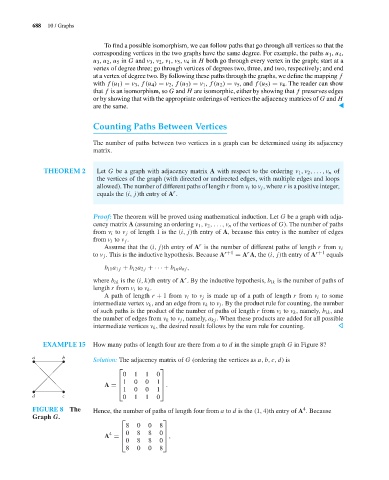
                                EXAMPLE 15      How many paths of length four are there from a to d in the simple graph G in Figure 8?

                             a        b
                                                Solution: The adjacency matrix of G (ordering the vertices as a, b, c, d)is
                                                        ⎡            ⎤
                                                          0  1   1  0
                                                          1  0   0  1
                                                        ⎢            ⎥
                                                    A =  ⎢           ⎥  .
                                                        ⎣ 1  0   0  1 ⎦
                             d         c                  0  1   1  0
                                                                                                                  4
                             FIGURE 8 The       Hence, the number of paths of length four from a to d is the (1, 4)th entry of A . Because
                             Graph G.
                                                         ⎡            ⎤
                                                          8   0   0  8
                                                     4   ⎢ 0  8   8  0 ⎥
                                                    A =  ⎢            ⎥  ,
                                                         ⎣ 0  8   8  0 ⎦
                                                          8   0   0  8

