


Page 131 -
P. 131
110    CHAPTER 10 Functional design


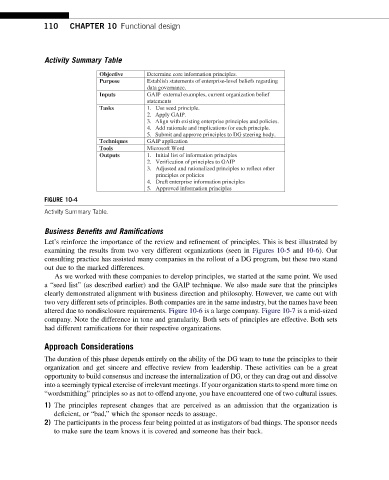
             Activity Summary Table
                             Objective    Determine core information principles.
                             Purpose      Establish statements of enterprise-level beliefs regarding
                                          data governance.
                             Inputs       GAIP  external examples, current organization belief
                                          statements
                             Tasks        1. Use seed principle.
                                          2. Apply GAIP.
                                          3. Align with existing enterprise principles and policies.
                                          4. Add rationale and implications for each principle.
                                          5. Submit and approve principles to DG steering body.
                             Techniques    GAIP application
                             Tools        Microsoft Word
                             Outputs      1. Initial list of information principles
                                          2. Verification of principles to GAIP
                                          3. Adjusted and rationalized principles to reflect other
                                            principles or policies
                                          4. Draft enterprise information principles
                                          5. Approved information principles
             FIGURE 10-4
             Activity Summary Table.


             Business Benefits and Ramifications
             Let’s reinforce the importance of the review and refinement of principles. This is best illustrated by
             examining the results from two very different organizations (seen in Figures 10-5 and 10-6). Our
             consulting practice has assisted many companies in the rollout of a DG program, but these two stand
             out due to the marked differences.
                As we worked with these companies to develop principles, we started at the same point. We used
             a “seed list” (as described earlier) and the GAIP technique. We also made sure that the principles
             clearly demonstrated alignment with business direction and philosophy. However, we came out with
             two very different sets of principles. Both companies are in the same industry, but the names have been
             altered due to nondisclosure requirements. Figure 10-6 is a large company. Figure 10-7 is a mid-sized
             company. Note the difference in tone and granularity. Both sets of principles are effective. Both sets
             had different ramifications for their respective organizations.

             Approach Considerations

             The duration of this phase depends entirely on the ability of the DG team to tune the principles to their
             organization and get sincere and effective review from leadership. These activities can be a great
             opportunity to build consensus and increase the internalization of DG, or they can drag out and dissolve
             into a seemingly typical exercise of irrelevant meetings. If your organization starts to spend more time on
             “wordsmithing” principles so as not to offend anyone, you have encountered one of two cultural issues.
             1) The principles represent changes that are perceived as an admission that the organization is
                deficient, or “bad,” which the sponsor needs to assuage.
             2) The participants in the process fear being pointed at as instigators of bad things. The sponsor needs
                to make sure the team knows it is covered and someone has their back.

