


Page 136 -
P. 136
Overview    115


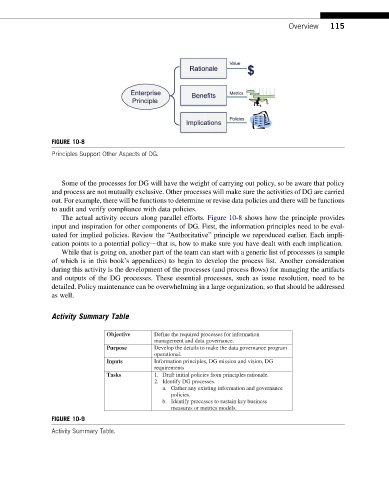
               FIGURE 10-8
               Principles Support Other Aspects of DG.


                  Some of the processes for DG will have the weight of carrying out policy, so be aware that policy
               and process are not mutually exclusive. Other processes will make sure the activities of DG are carried
               out. For example, there will be functions to determine or revise data policies and there will be functions
               to audit and verify compliance with data policies.
                  The actual activity occurs along parallel efforts. Figure 10-8 shows how the principle provides
               input and inspiration for other components of DG. First, the information principles need to be eval-
               uated for implied policies. Review the “Authoritative” principle we reproduced earlier. Each impli-
               cation points to a potential policydthat is, how to make sure you have dealt with each implication.
                  While that is going on, another part of the team can start with a generic list of processes (a sample
               of which is in this book’s appendices) to begin to develop the process list. Another consideration
               during this activity is the development of the processes (and process flows) for managing the artifacts
               and outputs of the DG processes. These essential processes, such as issue resolution, need to be
               detailed. Policy maintenance can be overwhelming in a large organization, so that should be addressed
               as well.
               Activity Summary Table


                               Objective    Define the required processes for information
                                            management and data governance.
                               Purpose      Develop the details to make the data governance program
                                            operational.
                               Inputs       Information principles, DG mission and vision, DG
                                            requirements
                               Tasks        1. Draft initial policies from principles rationale.
                                            2. Identify DG processes.
                                              a. Gather any existing information and governance
                                                policies.
                                              b. Identify processes to sustain key business
                                                measures or metrics models.
               FIGURE 10-9
               Activity Summary Table.

