


Page 140 -
P. 140
Overview    119


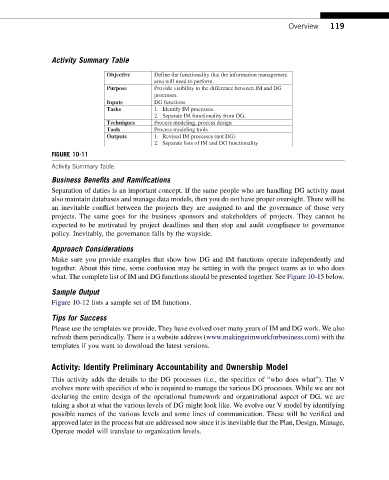
               Activity Summary Table

                               Objective    Define the functionality that the information management
                                            area will need to perform.
                               Purpose      Provide visibility to the difference between IM and DG
                                            processes.
                               Inputs       DG functions
                               Tasks        1. Identify IM processes.
                                            2. Separate IM functionality from DG.
                               Techniques    Process modeling, process design
                               Tools        Process modeling tools
                               Outputs      1. Revised IM processes (not DG)
                                            2. Separate lists of IM and DG functionality
               FIGURE 10-11
               Activity Summary Table.
               Business Benefits and Ramifications

               Separation of duties is an important concept. If the same people who are handling DG activity must
               also maintain databases and manage data models, then you do not have proper oversight. There will be
               an inevitable conflict between the projects they are assigned to and the governance of those very
               projects. The same goes for the business sponsors and stakeholders of projects. They cannot be
               expected to be motivated by project deadlines and then stop and audit compliance to governance
               policy. Inevitably, the governance falls by the wayside.
               Approach Considerations

               Make sure you provide examples that show how DG and IM functions operate independently and
               together. About this time, some confusion may be setting in with the project teams as to who does
               what. The complete list of IM and DG functions should be presented together. See Figure 10-15 below.
               Sample Output

               Figure 10-12 lists a sample set of IM functions.
               Tips for Success

               Please use the templates we provide. They have evolved over many years of IM and DG work. We also
               refresh them periodically. There is a website address (www.makingeimworkforbusiness.com) with the
               templates if you want to download the latest versions.

               Activity: Identify Preliminary Accountability and Ownership Model

               This activity adds the details to the DG processes (i.e., the specifics of “who does what”). The V
               evolves more with specifics of who is required to manage the various DG processes. While we are not
               declaring the entire design of the operational framework and organizational aspect of DG, we are
               taking a shot at what the various levels of DG might look like. We evolve our V model by identifying
               possible names of the various levels and some lines of communication. These will be verified and
               approved later in the process but are addressed now since it is inevitable that the Plan, Design, Manage,
               Operate model will translate to organization levels.

