


Page 108 - Design of Solar Thermal Power Plants
P. 108
96        2. THE SOLAR RESOURCE AND METEOROLOGICAL PARAMETERS

            2.7.4 Regionalization of China’s Solar Resource
               To facilitate the exploration and utilization of the solar resource in
            China, China’s solar resource has a three-level division distribution in
            which the indices of the first-level division are the levels of global annual
                                                      2
            radiation on the horizontal surface [kWh/(m $a)]. The distribution of
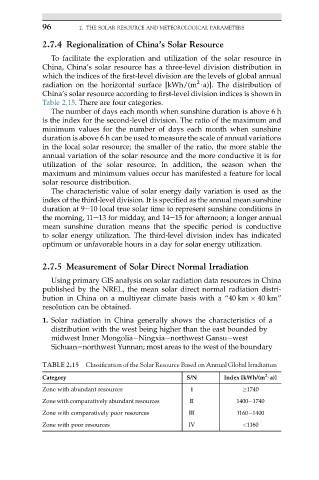
            China’s solar resource according to first-level division indices is shown in
            Table 2.15. There are four categories.
               The number of days each month when sunshine duration is above 6 h
            is the index for the second-level division. The ratio of the maximum and
            minimum values for the number of days each month when sunshine
            duration is above 6 h can be used to measure the scale of annual variations
            in the local solar resource; the smaller of the ratio, the more stable the
            annual variation of the solar resource and the more conductive it is for
            utilization of the solar resource. In addition, the season when the
            maximum and minimum values occur has manifested a feature for local
            solar resource distribution.
               The characteristic value of solar energy daily variation is used as the
            index of the third-level division. It is specified as the annual mean sunshine
            duration at 9e10 local true solar time to represent sunshine conditions in
            the morning, 11e13 for midday, and 14e15 for afternoon; a longer annual
            mean sunshine duration means that the specific period is conductive
            to solar energy utilization. The third-level division index has indicated
            optimum or unfavorable hours in a day for solar energy utilization.

            2.7.5 Measurement of Solar Direct Normal Irradiation

               Using primary GIS analysis on solar radiation data resources in China
            published by the NREL, the mean solar direct normal radiation distri-
            bution in China on a multiyear climate basis with a “40 km   40 km”
            resolution can be obtained.

            1. Solar radiation in China generally shows the characteristics of a
               distribution with the west being higher than the east bounded by
               midwest Inner MongoliaeNingxiaenorthwest Gansuewest
               Sichuanenorthwest Yunnan; most areas to the west of the boundary

            TABLE 2.15 Classification of the Solar Resource Based on Annual Global Irradiation
                                                                         2
            Category                               S/N        Index [kWh/(m $a)]
            Zone with abundant resources             I             1740
            Zone with comparatively abundant resources  II       1400e1740
            Zone with comparatively poor resources  III          1160e1400
            Zone with poor resources                IV             <1160

