


Page 109 - Design of Solar Thermal Power Plants
P. 109
2.7 DISTRIBUTION OF SOLAR DIRECT NORMAL RADIATION  97

                                                                    2
              have annual total direct solar irradiation above 1400 kWh/m ,
              showing zonal distribution characteristics of the south being higher
              than the north; areas to the east of the boundary have annual total
                                                         2
              direct solar irradiation of less than 1400 kWh/m ; North China has
              the largest amount.
              The national annual mean solar direct normal irradiation is
                         2
              1472 kWh/m . The area southwest of Tibet is an extremely high-value
              zone, while the extremely low-value zone is located in the Shannan
              Prefecture of Tibet, Sichuan Basin, and ChongqingeGuizhoueHunan
              region.
           2. Based on the geographic statistics of solar radiation resources in
              various provinces (cities, districts), annual total direct solar
              irradiation on an average climate condition in various provinces
              (cities, regions) can be obtained. Tibet, Qinghai, Xinjiang, Gansu,
              Ningxia, and Inner Mongolia are the provinces (regions) in China
              with the most abundant solar radiation resources, while various
              provinces (cities, regions) in North China and Yunnan have
              intermediate radiation resources, and Chongqing, Guizhou, and
              Hunan have the poorest radiation resources.
           3. During a clear day, the global irradiance on the horizontal surface is
              less than the DNI; during a cloudy day, the global irradiance on the
              horizontal surface is more than the DNI. Therefore, in northwestern
              areas of China with fewer cloudy days, DNI values are higher than
              the global irradiance on the horizontal surface.

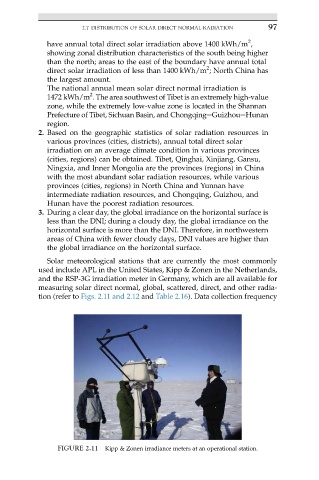
              Solar meteorological stations that are currently the most commonly
           used include APL in the United States, Kipp & Zonen in the Netherlands,
           and the RSP-3G irradiation meter in Germany, which are all available for
           measuring solar direct normal, global, scattered, direct, and other radia-
           tion (refer to Figs. 2.11 and 2.12 and Table 2.16). Data collection frequency


                 FIGURE 2.11  Kipp & Zonen irradiance meters at an operational station.

