


Page 232 - Design of Solar Thermal Power Plants
P. 232
3.8 DETERMINATION OF THERMAL STORAGE RESERVE   215

              Step II: Calculation of influences of different thermal storage periods
           on generating cost.
              The value of the thermal storage period direct influences on the vari-
           ation in the initial investment cost of the solar power plant, which further
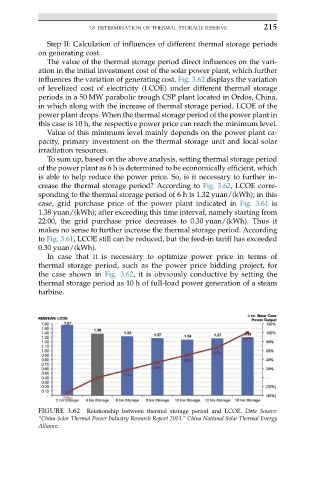
           influences the variation of generating cost. Fig. 3.62 displays the variation
           of levelized cost of electricity (LCOE) under different thermal storage
           periods in a 50 MW parabolic trough CSP plant located in Ordos, China,
           in which along with the increase of thermal storage period, LCOE of the
           power plant drops. When the thermal storage period of the power plant in
           this case is 10 h, the respective power price can reach the minimum level.
              Value of this minimum level mainly depends on the power plant ca-
           pacity, primary investment on the thermal storage unit and local solar
           irradiation resources.
              To sum up, based on the above analysis, setting thermal storage period
           of the power plant as 6 h is determined to be economically efficient, which
           is able to help reduce the power price. So, is it necessary to further in-
           crease the thermal storage period? According to Fig. 3.62, LCOE corre-
           sponding to the thermal storage period of 6 h is 1.32 yuan/(kWh); in this
           case, grid purchase price of the power plant indicated in Fig. 3.61 is
           1.38 yuan/(kWh); after exceeding this time interval, namely starting from
           22:00, the grid purchase price decreases to 0.30 yuan/(kWh). Thus it
           makes no sense to further increase the thermal storage period. According
           to Fig. 3.61, LCOE still can be reduced, but the feed-in tariff has exceeded
           0.30 yuan/(kWh).
              In case that it is necessary to optimize power price in terms of
           thermal storage period, such as the power price bidding project, for
           the case shown in Fig. 3.62, it is obviously conductive by setting the
           thermal storage period as 10 h of full-load power generation of a steam
           turbine.


           FIGURE 3.62   Relationship between thermal storage period and LCOE. Data Source:
           “China Solar Thermal Power Industry Research Report 2013,” China National Solar Thermal Energy
           Alliance.

