


Page 286 - Design of Solar Thermal Power Plants
P. 286
268              4. DESIGN OF THE CONCENTRATION SYSTEM

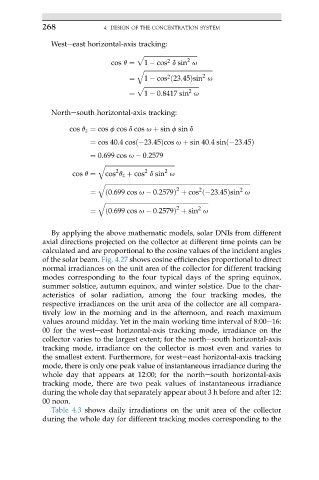
               Westeeast horizontal-axis tracking:

                                      p ffiffiffiffiffiffiffiffiffiffiffiffiffiffiffiffiffiffiffiffiffiffiffiffiffiffiffiffiffiffiffiffiffiffiffi
                                                    2
                                              2
                               cos q ¼  1   cos d sin u
                                      q ffiffiffiffiffiffiffiffiffiffiffiffiffiffiffiffiffiffiffiffiffiffiffiffiffiffiffiffiffiffiffiffiffiffiffiffiffiffiffiffiffiffiffiffiffi
                                                        2
                                              2
                                    ¼   1   cos ð23:45Þsin u
                                      p ffiffiffiffiffiffiffiffiffiffiffiffiffiffiffiffiffiffiffiffiffiffiffiffiffiffiffiffiffiffiffiffiffiffiffiffi
                                                    2
                                    ¼   1   0:8417 sin u
               Northesouth horizontal-axis tracking:
                    cos q z ¼ cos f cos d cos u þ sin f sin d
                         ¼ cos 40:4 cosð 23:45Þcos u þ sin 40:4 sinð 23:45Þ
                         ¼ 0:699 cos u   0:2579
                           q ffiffiffiffiffiffiffiffiffiffiffiffiffiffiffiffiffiffiffiffiffiffiffiffiffiffiffiffiffiffiffiffiffiffiffiffiffiffiffiffiffiffiffiffiffiffi
                                2
                                        2
                                              2
                     cos q ¼  cos q z þ cos d sin u
                           q ffiffiffiffiffiffiffiffiffiffiffiffiffiffiffiffiffiffiffiffiffiffiffiffiffiffiffiffiffiffiffiffiffiffiffiffiffiffiffiffiffiffiffiffiffiffiffiffiffiffiffiffiffiffiffiffiffiffiffiffiffiffiffiffiffiffiffiffiffiffiffiffiffiffiffiffiffiffiffiffiffiffiffiffiffiffiffiffiffiffiffiffiffiffi
                                                 2     2          2
                         ¼   ð0:699 cos u   0:2579Þ þ cos ð 23:45Þsin u
                           q ffiffiffiffiffiffiffiffiffiffiffiffiffiffiffiffiffiffiffiffiffiffiffiffiffiffiffiffiffiffiffiffiffiffiffiffiffiffiffiffiffiffiffiffiffiffiffiffiffiffiffiffiffiffiffiffiffiffiffiffiffiffiffiffiffiffiffi
                                                 2     2
                         ¼   ð0:699 cos u   0:2579Þ þ sin u
               By applying the above mathematic models, solar DNIs from different
            axial directions projected on the collector at different time points can be
            calculated and are proportional to the cosine values of the incident angles
            of the solar beam. Fig. 4.27 shows cosine efficiencies proportional to direct
            normal irradiances on the unit area of the collector for different tracking
            modes corresponding to the four typical days of the spring equinox,
            summer solstice, autumn equinox, and winter solstice. Due to the char-
            acteristics of solar radiation, among the four tracking modes, the
            respective irradiances on the unit area of the collector are all compara-
            tively low in the morning and in the afternoon, and reach maximum
            values around midday. Yet in the main working time interval of 8:00e16:
            00 for the westeeast horizontal-axis tracking mode, irradiance on the
            collector varies to the largest extent; for the northesouth horizontal-axis
            tracking mode, irradiance on the collector is most even and varies to
            the smallest extent. Furthermore, for westeeast horizontal-axis tracking
            mode, there is only one peak value of instantaneous irradiance during the
            whole day that appears at 12:00; for the northesouth horizontal-axis
            tracking mode, there are two peak values of instantaneous irradiance
            during the whole day that separately appear about 3 h before and after 12:
            00 noon.
               Table 4.3 shows daily irradiations on the unit area of the collector
            during the whole day for different tracking modes corresponding to the

