


Page 181 - Designing Autonomous Mobile Robots : Inside the Mindo f an Intellegent Machine
P. 181
Chapter 11

            The correction we will actually make for each axis is calculated as it was for azimuth,
            by multiplying the full implied correction (error) by the Q factor for the whole fit.
                       x    = – (Q    * E )                                  (Equation 11.13)
                        COR       FITx   x
                       And
                       y COR  = – (Q FITy  * E )                             (Equation 11.14)
                                         y
            Assume that this robot had begun this whole process with significant uncertainty for
            both azimuth and position, and had suddenly started to get good images of these col-
            umns. It would not have corrected all of its axes at the same rate.

            At first, the most improvement would be in the azimuth (the most important degree
            of freedom), then in the lateral position, and then, somewhat more slowly, the
            longitudinal position. This would be because the corrections in the azimuth would
            reduce the azimuth uncertainty, which would increase the observation quality for
            the position measurements. However, we have only discussed how uncertainty
            grows, not how it is reduced.


            Other profiles
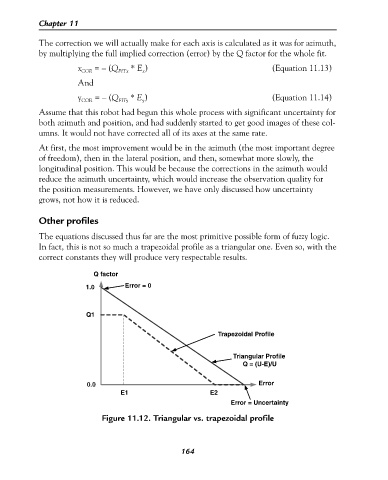
            The equations discussed thus far are the most primitive possible form of fuzzy logic.
            In fact, this is not so much a trapezoidal profile as a triangular one. Even so, with the
            correct constants they will produce very respectable results.

                           Q factor
                         1.0        Error = 0


                         Q1


                                                              Trapezoidal Profile

                                                                  Triangular Profile
                                                                    Q = (U-E)/U

                         0.0                                             Error
                                   E1                      E2
                                                                 Error = Uncertainty

                             Figure 11.12. Triangular vs. trapezoidal profile


                                                   164

