


Page 180 - Designing Autonomous Mobile Robots : Inside the Mindo f an Intellegent Machine
P. 180
Hard Navigation vs. Fuzzy Navigation

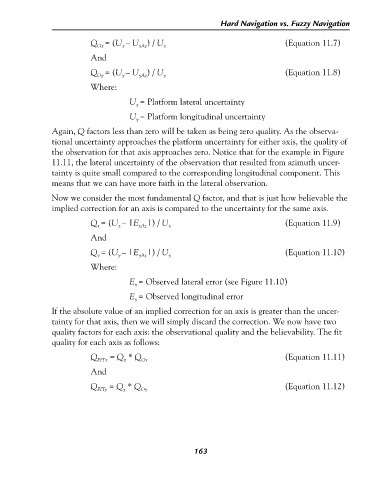
                          Q = (U – U ) / U    x                                 (Equation 11.7)
                                        xAz
                                   x
                            Ox
                          And
                          Q = (U – U ) / U                                      (Equation 11.8)
                            Oy     y    yAz   y
                          Where:

                                     U = Platform lateral uncertainty
                                       x
                                     U = Platform longitudinal uncertainty
                                       y
               Again, Q factors less than zero will be taken as being zero quality. As the observa-
               tional uncertainty approaches the platform uncertainty for either axis, the quality of
               the observation for that axis approaches zero. Notice that for the example in Figure
               11.11, the lateral uncertainty of the observation that resulted from azimuth uncer-
               tainty is quite small compared to the corresponding longitudinal component. This
               means that we can have more faith in the lateral observation.

               Now we consider the most fundamental Q factor, and that is just how believable the
               implied correction for an axis is compared to the uncertainty for the same axis.
                          Q = (U – |E |) / U    x                               (Equation 11.9)
                            x
                                        xAz
                                  x
                          And
                          Q = (U – |E |) / U    y                               (Equation 11.10)
                                  y
                            y
                                        yAz
                          Where:
                                     E = Observed lateral error (see Figure 11.10)
                                      x
                                     E = Observed longitudinal error
                                      y
               If the absolute value of an implied correction for an axis is greater than the uncer-
               tainty for that axis, then we will simply discard the correction. We now have two
               quality factors for each axis: the observational quality and the believability. The fit
               quality for each axis as follows:
                          Q FITx  = Q  * Q Ox                                   (Equation 11.11)
                                   x
                          And
                          Q FITy  = Q  * Q Oy                                   (Equation 11.12)
                                   y


                                                       163

