


Page 92 - Designing Autonomous Mobile Robots : Inside the Mindo f an Intellegent Machine
P. 92
Closed Loop Controls, Rabbits and Hounds

               Rabbits chasing rabbits

               The smoother the rabbit’s motion, the more likely the servo will be able to track it
               closely. For this reason, linear approximations (trapezoidal profiles) are not generally
               acceptable. Such a profile demands infinite acceleration at the knee points. Com-
               mand curves with low second derivatives (jerk term) are also essential in some cases.

               When we ascend to the level of making a robot navigate, there is much more in-
               volved than a simple single-axis servo chasing its rabbit. We must first generate a
               position rabbit that runs through imaginary space, and then determine the behavior
               we want from the steering and/or drive motors in order to follow it. If we are execut-
               ing an arc, then the steering rabbit must be slaved to the drive rabbit, and both must
               be slaved to the position rabbit.
               We will discuss some of these issues in the following chapters. The important thing
               to remember is that the most elaborate building is made of lots of simple blocks.
               Likewise, all complex systems are constructed from simpler blocks. If these blocks
               are understood and perfected, they can be used to create systems that dependably
               generate very complex behavior.


               Conclusions

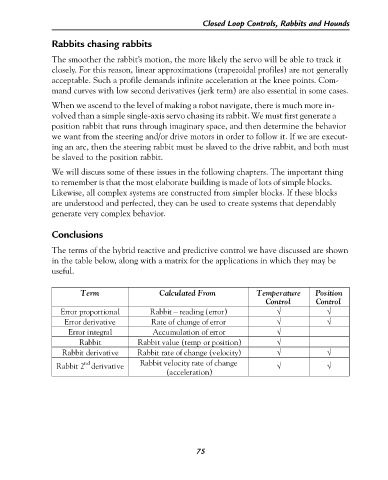
               The terms of the hybrid reactive and predictive control we have discussed are shown
               in the table below, along with a matrix for the applications in which they may be
               useful.


                       Term                  Calculated From            Temperature      Position
                                                                           Control       Control
                  Error proportional       Rabbit – reading (error)           √             √
                   Error derivative        Rate of change of error            √             √
                    Error integral         Accumulation of error              √
                       Rabbit          Rabbit value (temp or position)        √
                  Rabbit derivative    Rabbit rate of change (velocity)       √             √
                        nd
                 Rabbit 2  derivative    Rabbit velocity rate of change       √             √
                                               (acceleration)


                                                        75

