


Page 127 - Designing Sociable Robots
P. 127
breazeal-79017  book  March 18, 2002  14:5


                       108                                                              Chapter 8


                       the emotion processes. Since the robot’s expressions reflect its affective state, the drives
                       indirectly control the affective cues the robot displays to people. Last, they provide a func-
                       tional context that organizes behavior and perception. This is of particular importance for
                       emotive appraisals.
                         The design of Kismet’s homeostatic regulation subsystem is heavily inspired by etholog-
                       ical views of the analogous process in animals (McFarland & Bosser, 1993). It is, however,
                       a simplified and idealized model of those discovered in living systems. One distinguishing
                       feature of a drive is its temporally cyclic behavior. That is, given no stimulation, a drive
                       will tend to increase in intensity unless it is satiated. This is analogous to an animal’s degree
                       of hunger or level of fatigue, both following a cyclical pattern.
                         Another distinguishing feature is its homeostatic nature. Each acts to maintain a level of
                       intensity within a bounded range (neither too much nor too little). Its change in intensity
                       reflects the ongoing needs of the robot and the urgency for tending to them. There is a
                       desired operational point for each drive and acceptable bounds of operation around that
                       point. I call this range the homeostatic regime. As long as a drive is within the homeostatic
                       regime, the robot’s needs are being adequately met. For Kismet, maintaining its drives
                       within their homeostatic regime is a never-ending process. At any point in time, the robot’s
                       behavior is organized about satiating one of its drives.
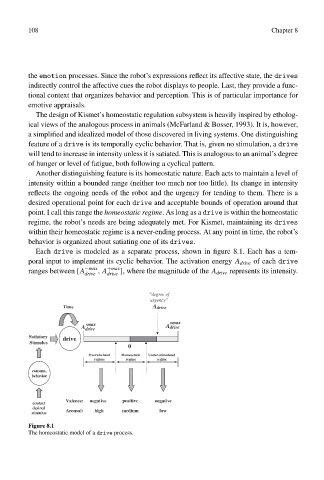
                         Each drive is modeled as a separate process, shown in figure 8.1. Each has a tem-
                       poral input to implement its cyclic behavior. The activation energy A drive of each drive
                                      −max  +max
                       ranges between [A  , A  ], where the magnitude of the A drive represents its intensity.
                                      drive  drive

                                                       “degree of
                                                       urgency”
                                Time                    A drive
                                      -max                   +max
                                     A drive                A drive
                       Satiatory  drive
                       Stimulus
                                                  0
                                       Overwhelmed  Homeostatic  Under-stimulated
                                        regime   regime  regime
                        consum.
                        behavior


                                 Valence:  negative  positive  negative
                        contact
                        desired
                        stimulus  Arousal:  high  medium  low
                       Figure 8.1
                       The homeostatic model of a drive process.

