


Page 130 - Designing Sociable Robots
P. 130
breazeal-79017  book  March 18, 2002  14:5


                       The Motivation System                                                111


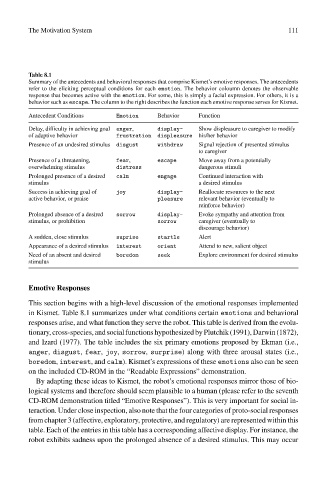
                       Table 8.1
                       Summary of the antecedents and behavioral responses that comprise Kismet’s emotive responses. The antecedents
                       refer to the eliciting perceptual conditions for each emotion. The behavior coloumn denotes the observable
                       response that becomes active with the emotion. For some, this is simply a facial expression. For others, it is a
                       behavior such as escape. The column to the right describes the function each emotive response serves for Kismet.
                       Antecedent Conditions  Emotion    Behavior   Function
                       Delay, difficulty in achieving goal  anger,  display-  Show displeasure to caregiver to modify
                       of adaptive behavior   frustration  displeasure  his/her behavior
                       Presence of an undesired stimulus  disgust  withdraw  Signal rejection of presented stimulus
                                                                    to caregiver
                       Presence of a threatening,  fear,  escape    Move away from a potentially
                       overwhelming stimulus  distress              dangerous stimuli
                       Prolonged presence of a desired  calm  engage  Continued interaction with
                       stimulus                                     a desired stimulus
                       Success in achieving goal of  joy  display-  Reallocate resources to the next
                       active behavior, or praise        pleasure   relevant behavior (eventually to
                                                                    reinforce behavior)
                       Prolonged absence of a desired  sorrow  display-  Evoke sympathy and attention from
                       stimulus, or prohibition          sorrow     caregiver (eventually to
                                                                    discourage behavior)
                       A sudden, close stimulus  suprise  startle   Alert
                       Appearance of a desired stimulus  interest  orient  Attend to new, salient object
                       Need of an absent and desired  boredom  seek  Explore environment for desired stimulus
                       stimulus


                       Emotive Responses

                       This section begins with a high-level discussion of the emotional responses implemented
                       in Kismet. Table 8.1 summarizes under what conditions certain emotions and behavioral
                       responses arise, and what function they serve the robot. This table is derived from the evolu-
                       tionary, cross-species, and social functions hypothesized by Plutchik (1991), Darwin (1872),
                       and Izard (1977). The table includes the six primary emotions proposed by Ekman (i.e.,
                       anger, disgust, fear, joy, sorrow, surprise) along with three arousal states (i.e.,
                       boredom, interest, and calm). Kismet’s expressions of these emotions also can be seen
                       on the included CD-ROM in the “Readable Expressions” demonstration.
                         By adapting these ideas to Kismet, the robot’s emotional responses mirror those of bio-
                       logical systems and therefore should seem plausible to a human (please refer to the seventh
                       CD-ROM demonstration titled “Emotive Responses”). This is very important for social in-
                       teraction. Under close inspection, also note that the four categories of proto-social responses
                       from chapter 3 (affective, exploratory, protective, and regulatory) are represented within this
                       table. Each of the entries in this table has a corresponding affective display. For instance, the
                       robot exhibits sadness upon the prolonged absence of a desired stimulus. This may occur

