


Page 132 - Designing Sociable Robots
P. 132
breazeal-79017  book  March 18, 2002  14:5


                       The Motivation System                                                113


                         In living systems, it is believed that these individual facets are organized in a highly
                       interdependent fashion. Physiological activity is hypothesized to physically prepare the
                       creature to act in ways motivated by action tendencies. Furthermore, both the physiological
                       activities and the action tendencies are organized around the adaptive implications of the
                       appraisals that elicited the emotions. From a functional perspective, Smith (1989) and
                       Russell (1997) suggest that the individual components of emotive facial expression are also
                       linked to these emotional facets in a highly systematic fashion.
                         In the remainder of this chapter, I discuss the relation between the eliciting condition(s),
                       appraisal, action tendency, behavioral response, and observable expression in Kismet’s
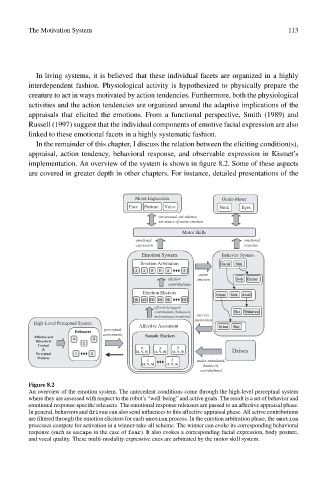
                       implementation. An overview of the system is shown in figure 8.2. Some of these aspects
                       are covered in greater depth in other chapters. For instance, detailed presentations of the


                                                   Motor Expression       Oculo-Motor
                                                 Face  Posture  Voice    Neck  Eyes
                                                         net arousal, net valence,
                                                         net stance of active emotion
                                                               Motor Skills
                                                   emotional                    emotional
                                                   expression                   response
                                                     Emotion System       Behavior System
                                                    Emotion Arbitration   Social  Stim
                                                   J  A  F  D  S  E
                                                                    active
                                                            elicitor  emotion  Seek  Engage
                                                            contributions
                                                     Emotion Elicitors
                                                                        Engage  Seek  Avoid
                                                   JE  AE  FE  DE  SE  EE
                                                        affectively tagged
                                                        contributions (behaviors,  Flee  Withdraw
                                                        motivations,perceptions)  success,
                                                                   frustration
                        High-Level Perceptual System
                                                    Affective Assesment  Orient  Play
                                           perceptual
                                   Releasers
                                          assessments  Somatic Markers
                        Affective and  α  β
                        Behavioral   χ
                         Context                     α   χ    β
                          &                                                  Drives
                         Perceptual  ε  δ          [A, V, S]  [A, V, S]  [A, V, S]
                         Features
                                                      ε      δ     under-stimulated,
                                                     [A, V, S]  [A, V, S]  balanced,
                                                                    overwhelmed
                       Figure 8.2
                       An overview of the emotion system. The antecedent conditions come through the high-level perceptual system
                       where they are assessed with respect to the robot’s “well-being” and active goals. The result is a set of behavior and
                       emotional response-specific releasers. The emotional response releasers are passed to an affective appraisal phase.
                       In general, behaviors and drives can also send influences to this affective appraisal phase. All active contributions
                       are filtered through the emotion elicitors for each emotion process. In the emotion arbitration phase, the emotion
                       processes compete for activation in a winner-take-all scheme. The winner can evoke its corresponding behavioral
                       response (such as escape in the case of fear). It also evokes a corresponding facial expression, body posture,
                       and vocal quality. These multi-modality expressive cues are arbitrated by the motor skill system.

