


Page 136 - Designing Sociable Robots
P. 136
breazeal-79017  book  March 18, 2002  14:5


                       The Motivation System                                                117


                       the net [A, V, S] lies within the arousal, valence, and stance boundaries that define the
                       corresponding emotion region shown in figure 8.3. This value is scaled with respect to
                       the size of the region so as to not favor the activation of some processes over others in
                       the arbitration phase. The contribution of each dimension to each elicitor is computed
                       individually. If any one of the dimensions is not represented, then the activation level is
                       set to zero. Otherwise, the A, V, and S contributions are summed together to arrive at
                       the activation level of the elicitor. This activation level is passed on to the corresponding
                       emotion process in the arbitration phase.
                         There are many different processes that contribute to the overall affective state. Influences
                       are sent by drives, the active behavior, and releasers. Several different schemes for com-
                       puting the net contribution to a given emotion process were tried, but this one has the nicest
                       properties. In an earlier version, all the incoming contributions were simply averaged. This
                       tended to “smooth” the net affective state to an unacceptable degree. For instance, if the
                       robot’s fatigue-drive is high (biasing a low arousal state) and a threatening toy appears
                       (contributing to a strong negative valence and high arousal), the averaging technique could
                       result in a slightly negative valence and neutral arousal. This is insufficient to evoke fear
                       and an escape response when the robot should protect itself. As an alternative, we could
                       hard-wire certain releasers directly to emotion processes. It is not clear, however, how this
                       approach supports the influence of drives and behaviors, whose affective contributions
                       change as a function of time. For instance, a given drive contributes to fear, sorrow,
                       or interest processes depending on its current activation regime. The current approach
                       balances the constraints of having certain releasers contribute heavily and directly to the
                       appropriate emotive response, while accommodating those influences that contribute to dif-
                       ferent emotions as a function of time. The end result also has nice properties for generating
                       facial expressions that reflect this assessment process in a rich way. This is important for
                       social interaction as originally argued by Darwin. This expressive benefit is discussed in
                       further detail in chapter 10.

                       Emotion Activation
                       Next, the activation level of each emotion process is computed. There is a process defined
                       for each emotion listed in table 8.1: joy, anger, disgust, fear, sorrow, surprise,
                       interest, boredom, and calm.
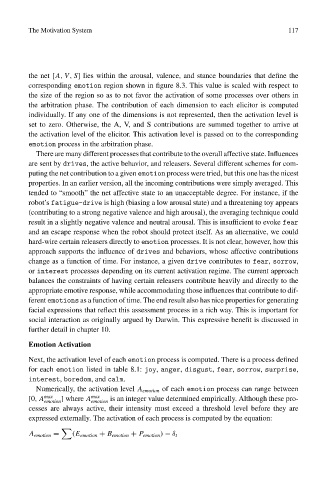
                         Numerically, the activation level A emotion of each emotion process can range between
                       [0, A max  ] where A max  is an integer value determined empirically. Although these pro-
                           emotion     emotion
                       cesses are always active, their intensity must exceed a threshold level before they are
                       expressed externally. The activation of each process is computed by the equation:

                       A emotion =  (E emotion + B emotion + P emotion ) − δ t

