


Page 140 - Designing Sociable Robots
P. 140
breazeal-79017  book  March 18, 2002  14:5


                       The Motivation System                                                121


                                               Interaction with Toy
                         2500
                                                                          Anger
                         2000                                             Fear
                        Activation Level  1500                            Sadness
                                                                          Interest

                         1000
                          500
                           0
                            0       20      40      60      80      100     120     140
                                                    Time (seconds)

                         2000

                         1000
                        Activation Level  0


                                      Stimulation drive
                         1000
                                      Play behavior
                                      Non face stimulus
                         2000
                            0       20      40      60      80      100     120     140
                                                    Time (seconds)
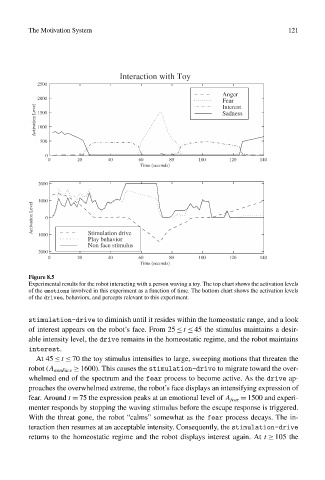
                       Figure 8.5
                       Experimental results for the robot interacting with a person waving a toy. The top chart shows the activation levels
                       of the emotions involved in this experiment as a function of time. The bottom chart shows the activation levels
                       of the drives, behaviors, and percepts relevant to this experiment.


                       stimulation-drive to diminish until it resides within the homeostatic range, and a look
                       of interest appears on the robot’s face. From 25 ≤ t ≤ 45 the stimulus maintains a desir-
                       able intensity level, the drive remains in the homeostatic regime, and the robot maintains
                       interest.
                         At 45 ≤ t ≤ 70 the toy stimulus intensifies to large, sweeping motions that threaten the
                       robot (A nonFace ≥ 1600). This causes the stimulation-drive to migrate toward the over-
                       whelmed end of the spectrum and the fear process to become active. As the drive ap-
                       proaches the overwhelmed extreme, the robot’s face displays an intensifying expression of
                       fear. Around t = 75 the expression peaks at an emotional level of A fear = 1500 and experi-
                       menter responds by stopping the waving stimulus before the escape response is triggered.
                       With the threat gone, the robot “calms” somewhat as the fear process decays. The in-
                       teraction then resumes at an acceptable intensity. Consequently, the stimulation-drive
                       returns to the homeostatic regime and the robot displays interest again. At t ≥ 105 the

