


Page 135 - Designing Sociable Robots
P. 135
breazeal-79017  book  March 18, 2002  14:5


                       116                                                              Chapter 8


                       In the current implementation, the affective tags for each releaser are specified by the
                       designer. These may be fixed constants, or linearly varying quantities. In all, there are three
                       contributing factors to the robot’s net affective state:

                       •  Drives Recall that each drive is partitioned into three regimes: homeostatic, over-
                       whelmed or under-stimulated. For a given drive, each regime potentiates arousal and
                       valence differently, which contribute to the activation of different emotion processes.
                       •  Behavior The success or delayed progress of the active behavior can directly influence the
                       affective state. Success contributes to positive emotive responses, whereas delayed progress
                       contributes to negative emotive responses such as frustration.

                       •  Releasers The external environmental factors that elicit emotive responses.
                       Emotion Elicitors
                       All somatically marked inputs are passed to the emotion elicitor stage. Recall from chap-
                       ter 7 that the elicitors filter each of the incoming [A, V, S] contributions to determine
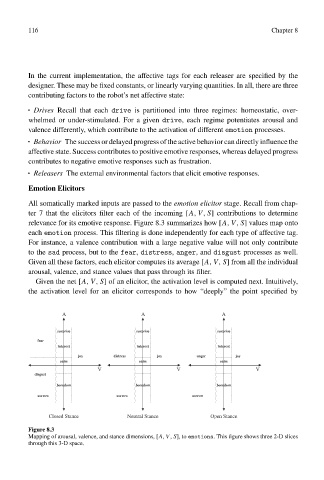
                       relevance for its emotive response. Figure 8.3 summarizes how [A, V, S] values map onto
                       each emotion process. This filtering is done independently for each type of affective tag.
                       For instance, a valence contribution with a large negative value will not only contribute
                       to the sad process, but to the fear, distress, anger, and disgust processes as well.
                       Given all these factors, each elicitor computes its average [A, V, S] from all the individual
                       arousal, valence, and stance values that pass through its filter.
                         Given the net [A, V, S] of an elicitor, the activation level is computed next. Intuitively,
                       the activation level for an elicitor corresponds to how “deeply” the point specified by


                                A                    A                    A

                               surprise             surprise             surprise
                         fear
                               interest             interest             interest
                                    joy       distress   joy        anger     joy
                               calm                 calm                  calm
                                         V                    V                    V
                         disgust
                              boredom              boredom               boredom
                         sorrow               sorrow              sorrow


                            Closed Stance        Neutral Stance        Open Stance
                       Figure 8.3
                       Mapping of arousal, valence, and stance dimensions, [A, V , S], to emotions. This figure shows three 2-D slices
                       through this 3-D space.

