


Page 138 - Designing Sociable Robots
P. 138
breazeal-79017  book  March 18, 2002  14:5


                       The Motivation System                                                119


                                Drives  over-          Emotion
                                                       Elicitors
                                     whelming               Sorrow   Disgust
                                                             V, S
                                                                      V,S
                                              high arousal,
                       Releasers                                           Anger
                                        Affective  negative  Surprise
                                       Assessment  valence,  A, S  Boredom  A,V
                         Big                                      S
                                              closed stance          Calm
                                        Threat                        S
                       Close  Threat
                                         SM
                                                         Fear    Joy      Interest
                        Fast                             A,V,S   A         A,S
                        Motion
                                 success,
                                frustration
                                          Emotion
                                         Arbitration
                           Behavior              Sorrow  Boredom
                           System                              Interest  Calm
                               Flee         Fear
                              Behavior
                                                  Surprise  Joy    Disgust  Anger
                          Motor               net arousal, valence, stance
                          Systems
                              Escape
                              Motor   Express  Express  Express
                               Skill   Voice  Face  Posture
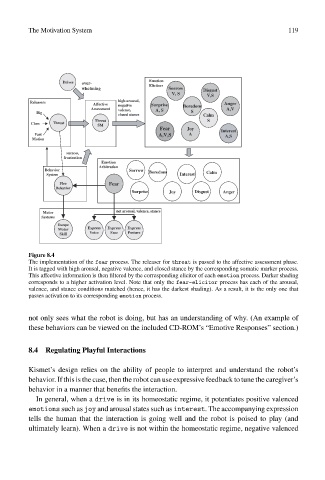
                       Figure 8.4
                       The implementation of the fear process. The releaser for threat is passed to the affective assessment phase.
                       It is tagged with high arousal, negative valence, and closed stance by the corresponding somatic marker process.
                       This affective information is then filtered by the corresponding elicitor of each emotion process. Darker shading
                       corresponds to a higher activation level. Note that only the fear-elicitor process has each of the arousal,
                       valence, and stance conditions matched (hence, it has the darkest shading). As a result, it is the only one that
                       passes activation to its corresponding emotion process.
                       not only sees what the robot is doing, but has an understanding of why. (An example of
                       these behaviors can be viewed on the included CD-ROM’s “Emotive Responses” section.)


                       8.4  Regulating Playful Interactions

                       Kismet’s design relies on the ability of people to interpret and understand the robot’s
                       behavior. If this is the case, then the robot can use expressive feedback to tune the caregiver’s
                       behavior in a manner that benefits the interaction.
                         In general, when a drive is in its homeostatic regime, it potentiates positive valenced
                       emotions such as joy and arousal states such as interest. The accompanying expression
                       tells the human that the interaction is going well and the robot is poised to play (and
                       ultimately learn). When a drive is not within the homeostatic regime, negative valenced

