


Page 141 - Designing Sociable Robots
P. 141
breazeal-79017  book  March 18, 2002  14:5


                       122                                                              Chapter 8


                                                 Sleep Behavior
                         2500
                                      Anger
                         2000         Tired
                        Activation Level  1500


                         1000
                         500

                           0
                           0         50        100        150       200       250
                                                     Time (seconds)
                         3500
                         3000         Fatigue drive
                                      Sleep behavior
                         2500
                        Activation Level  2000
                                      NonFace stimulus
                         1500
                         1000
                         500
                           0
                           0         50        100        150       200       250
                                                     Time (seconds)
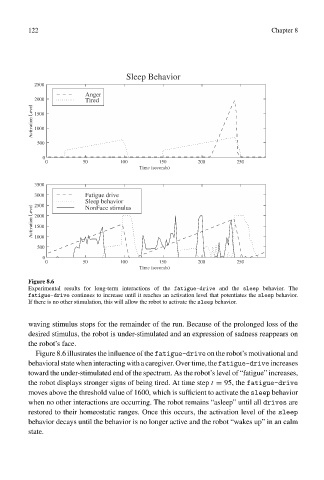
                       Figure 8.6
                       Experimental results for long-term interactions of the fatigue-drive and the sleep behavior. The
                       fatigue-drive continues to increase until it reaches an activation level that potentiates the sleep behavior.
                       If there is no other stimulation, this will allow the robot to activate the sleep behavior.

                       waving stimulus stops for the remainder of the run. Because of the prolonged loss of the
                       desired stimulus, the robot is under-stimulated and an expression of sadness reappears on
                       the robot’s face.
                         Figure 8.6 illustrates the influence of the fatigue-drive on the robot’s motivational and
                       behavioral state when interacting with a caregiver. Over time, the fatigue-drive increases
                       toward the under-stimulated end of the spectrum. As the robot’s level of “fatigue” increases,
                       the robot displays stronger signs of being tired. At time step t = 95, the fatigue-drive
                       moves above the threshold value of 1600, which is sufficient to activate the sleep behavior
                       when no other interactions are occurring. The robot remains “asleep” until all drives are
                       restored to their homeostatic ranges. Once this occurs, the activation level of the sleep
                       behavior decays until the behavior is no longer active and the robot “wakes up” in an calm
                       state.

