


Page 151 - Designing Sociable Robots
P. 151
breazeal-79017  book  March 18, 2002  14:7


                       132                                                              Chapter 9


                                               Hormones

                       Migration
                                       Shallow warm water
                                                       Spring
                                              Plants
                                                       migration
                       Territory        Internal factors
                             Eggs,      Nesting
                            young       material           IRM
                                Parental
                       Mating   Behavior  Courtship  Nesting  Fighting
                                                           IRM
                                                         Rival
                       Consummatory    Chasing  Biting  Display  Display
                       Action
                                                           IRM
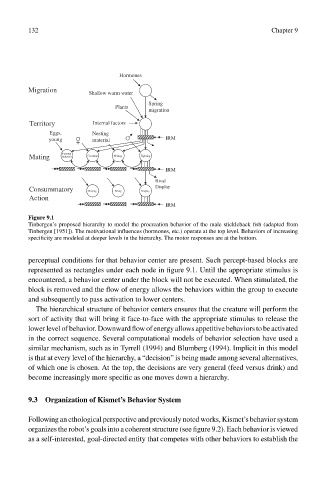
                       Figure 9.1
                       Tinbergen’s proposed hierarchy to model the procreation behavior of the male stickleback fish (adapted from
                       Tinbergen [1951]). The motivational influences (hormones, etc.) operate at the top level. Behaviors of increasing
                       specificity are modeled at deeper levels in the hierarchy. The motor responses are at the bottom.


                       perceptual conditions for that behavior center are present. Such percept-based blocks are
                       represented as rectangles under each node in figure 9.1. Until the appropriate stimulus is
                       encountered, a behavior center under the block will not be executed. When stimulated, the
                       block is removed and the flow of energy allows the behaviors within the group to execute
                       and subsequently to pass activation to lower centers.
                         The hierarchical structure of behavior centers ensures that the creature will perform the
                       sort of activity that will bring it face-to-face with the appropriate stimulus to release the
                       lower level of behavior. Downward flow of energy allows appetitive behaviors to be activated
                       in the correct sequence. Several computational models of behavior selection have used a
                       similar mechanism, such as in Tyrrell (1994) and Blumberg (1994). Implicit in this model
                       is that at every level of the hierarchy, a “decision” is being made among several alternatives,
                       of which one is chosen. At the top, the decisions are very general (feed versus drink) and
                       become increasingly more specific as one moves down a hierarchy.


                       9.3 Organization of Kismet’s Behavior System

                       Following an ethological perspective and previously noted works, Kismet’s behavior system
                       organizes the robot’s goals into a coherent structure (see figure 9.2). Each behavior is viewed
                       as a self-interested, goal-directed entity that competes with other behaviors to establish the

