


Page 152 - Designing Sociable Robots
P. 152
breazeal-79017  book  March 18, 2002  14:7


                       The Behavior System                                                  133


                                             Social    Fatigue  Stimulation
                                             Drive     Drive     Drive


                                     People  Satiate   Satiate   Satiate  Toy
                                     Present  Social   Fatigue  Stimulation  Present


                               Intense  Good  No                     No   Good  Intense
                               or Bad   People  People  No  Stimuli  Toy  Toy  or Bad
                                                     Stimuli  Present
                               Avoid  Engage  Seek                   Seek  Engage  Avoid
                                Stim  People  People      Quiet      Toys  Toy  Stim
                                                     Sleep
                                                          Down

                                                                            Undesired  Threat  Annoying
                        Undesired  Threat  Annoying                         Stimulus  Stimulus  Stimulus
                        Stimulus  timulus  Stimulus
                                                                            Reject
                         Reject  Escape  Withdraw                            Face  Escape  Withdraw
                         Toy
                                             New &  Talking  Close &  Good Toy
                                        Distant  Close  & Close  Quiet  Good
                                        Person                 & Vocal  Toy
                                             Person  Face  Person  Present  Present
                                        Call to  Greet  Vocal  Attentive  Play with  Orient
                                        Person  Person  Play  Regard  Toy  to Toy


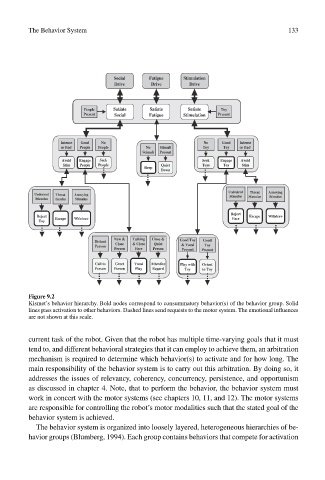
                       Figure 9.2
                       Kismet’s behavior hierarchy. Bold nodes correspond to consummatory behavior(s) of the behavior group. Solid
                       lines pass activation to other behaviors. Dashed lines send requests to the motor system. The emotional influences
                       are not shown at this scale.


                       current task of the robot. Given that the robot has multiple time-varying goals that it must
                       tend to, and different behavioral strategies that it can employ to achieve them, an arbitration
                       mechanism is required to determine which behavior(s) to activate and for how long. The
                       main responsibility of the behavior system is to carry out this arbitration. By doing so, it
                       addresses the issues of relevancy, coherency, concurrency, persistence, and opportunism
                       as discussed in chapter 4. Note, that to perform the behavior, the behavior system must
                       work in concert with the motor systems (see chapters 10, 11, and 12). The motor systems
                       are responsible for controlling the robot’s motor modalities such that the stated goal of the
                       behavior system is achieved.
                         The behavior system is organized into loosely layered, heterogeneous hierarchies of be-
                       havior groups (Blumberg, 1994). Each group contains behaviors that compete for activation

