


Page 154 - Designing Sociable Robots
P. 154
breazeal-79017  book  March 18, 2002  14:7


                       The Behavior System                                                  135


                               Level of Interest,
                                 Frustration  Activation Level,
                                                   A
                       Behavior Group
                         Releasers
                                 Behavior
                         Emotion,  Bias
                          Drive                            A  ma x
                                       0
                                         Threshold,
                        Goal Releaser       T
                                 [A, V, S]
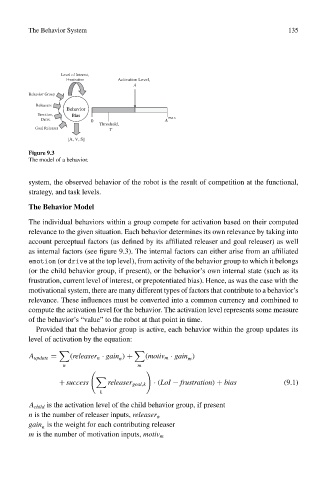
                       Figure 9.3
                       The model of a behavior.


                       system, the observed behavior of the robot is the result of competition at the functional,
                       strategy, and task levels.

                       The Behavior Model
                       The individual behaviors within a group compete for activation based on their computed
                       relevance to the given situation. Each behavior determines its own relevance by taking into
                       account perceptual factors (as defined by its affiliated releaser and goal releaser) as well
                       as internal factors (see figure 9.3). The internal factors can either arise from an affiliated
                       emotion (or drive at the top level), from activity of the behavior group to which it belongs
                       (or the child behavior group, if present), or the behavior’s own internal state (such as its
                       frustration, current level of interest, or prepotentiated bias). Hence, as was the case with the
                       motivational system, there are many different types of factors that contribute to a behavior’s
                       relevance. These influences must be converted into a common currency and combined to
                       compute the activation level for the behavior. The activation level represents some measure
                       of the behavior’s “value” to the robot at that point in time.
                         Provided that the behavior group is active, each behavior within the group updates its
                       level of activation by the equation:

                       A update =  (releaser n · gain ) +  (motiv m · gain )
                                               n                 m
                                n                   m


                               + success    releaser goal,k  · (LoI − frustration) + bias  (9.1)
                                          k
                       A child is the activation level of the child behavior group, if present
                       n is the number of releaser inputs, releaser n
                       gain is the weight for each contributing releaser
                          n
                       m is the number of motivation inputs, motiv m

