


Page 158 - Designing Sociable Robots
P. 158
breazeal-79017  book  March 18, 2002  14:7


                       The Behavior System                                                  139


                       9.4  Kismet’s Proto-Social Responses

                       In the current implementation of the behavior system there are three primary branches,
                       each specialized for addressing a different need. Each is comprised of multiple levels,
                       with three layers being the deepest (see figure 9.2). Each level of the hierarchy serves a
                       different function and addresses a different set of issues. As one moves down in depth, the
                       behaviors serve to more finely tune the relation between the robot and its environment, and
                       in particular, the relation between the robot and the human (Breazeal & Scassellati, 2000).

                       Level Zero: The Functional Level
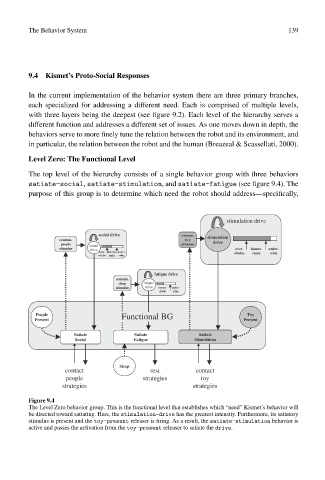
                       The top level of the hierarchy consists of a single behavior group with three behaviors
                       satiate-social, satiate-stimulation, and satiate-fatigue (see figure 9.4). The
                       purpose of this group is to determine which need the robot should address—specifically,


                                                                           stimulation drive

                                         social drive          consum.  stimulation
                               consum.                          to y    drive
                               people                          stimulus
                                       social
                               stimulus                                       over-  homeo-  under-
                                       drive
                                         over-  homeo- under-                whelm.  static  stim.
                                         whelm.  static  stim.
                                                        fatigue drive
                                              consum.
                                              sleep  fatigue
                                              stimulus  drive  homeo-  under-
                                                         static  stim.
                        People                 Functional BG                     Toy
                        Present                                                 Present
                                   Satiate         Satiate          Satiate
                                   Social          Fatigue         Stimulation


                                               Sleep
                                contact                rest        contact
                                people               strategies     toy
                                strategies                        strategies
                       Figure 9.4
                       The Level Zero behavior group. This is the functional level that establishes which “need” Kismet’s behavior will
                       be directed toward satiating. Here, the stimulation-drive has the greatest intensity. Furthermore, its satiatory
                       stimulus is present and the toy-present releaser is firing. As a result, the satiate-stimulation behavior is
                       active and passes the activation from the toy-present releaser to satiate the drive.

