


Page 161 - Designing Sociable Robots
P. 161
breazeal-79017  book  March 18, 2002  14:7


                       142                                                              Chapter 9


                                           Social Regulation BG
                                          Intense  Avoid
                                          or Bad
                                                 Stimulus
                                          Stim

                                           Social Protective BG
                        Disgust           Distress           Fear
                                 Reject
                        Undesire.         Annoy.  Withdraw   Threat  Escape
                         Toy     Toy       Stim              Stim
                          No               Good             Escaped
                         Toy               Stim              Stim
                                  [A, V, S]         [A, V, S]         [A, V, S]
                               Reject            Withdraw           Flee
                              Motor Skill       Motor Skill       Motor Skill
                               Request           Request           Request
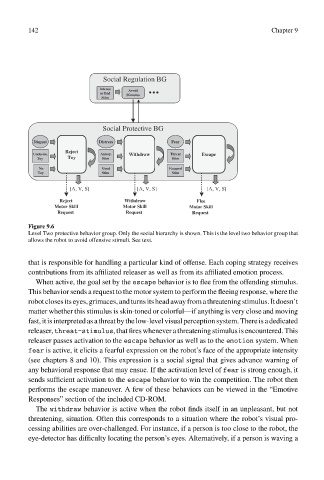
                       Figure 9.6
                       Level Two protective behavior group. Only the social hierarchy is shown. This is the level two behavior group that
                       allows the robot to avoid offensive stimuli. See text.


                       that is responsible for handling a particular kind of offense. Each coping strategy receives
                       contributions from its affiliated releaser as well as from its affiliated emotion process.
                         When active, the goal set by the escape behavior is to flee from the offending stimulus.
                       This behavior sends a request to the motor system to perform the fleeing response, where the
                       robotclosesitseyes,grimaces,andturnsitsheadawayfromathreateningstimulus.Itdoesn’t
                       matter whether this stimulus is skin-toned or colorful—if anything is very close and moving
                       fast,itisinterpretedasathreatbythelow-levelvisualperceptionsystem.Thereisadedicated
                       releaser, threat-stimulus, that fires whenever a threatening stimulus is encountered. This
                       releaser passes activation to the escape behavior as well as to the emotion system. When
                       fear is active, it elicits a fearful expression on the robot’s face of the appropriate intensity
                       (see chapters 8 and 10). This expression is a social signal that gives advance warning of
                       any behavioral response that may ensue. If the activation level of fear is strong enough, it
                       sends sufficient activation to the escape behavior to win the competition. The robot then
                       performs the escape maneuver. A few of these behaviors can be viewed in the “Emotive
                       Responses” section of the included CD-ROM.
                         The withdraw behavior is active when the robot finds itself in an unpleasant, but not
                       threatening, situation. Often this corresponds to a situation where the robot’s visual pro-
                       cessing abilities are over-challenged. For instance, if a person is too close to the robot, the
                       eye-detector has difficulty locating the person’s eyes. Alternatively, if a person is waving a

